Record revealed
Japanese Instrument of Surrender, 1945
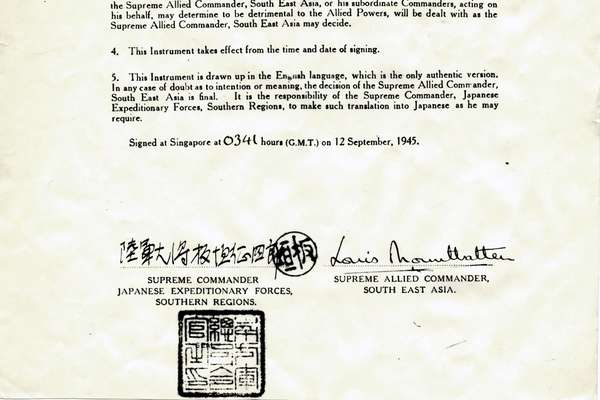
After six years of brutal global conflict, this document marked the end of the Second World War.
Series
Catalogue reference: WO 301
WO 301
Topographical, reconnaissance and operations (trench) maps and diagrams; Admiralty charts and naval operations diagrams (at 1:24 000 and 1:26 000); air photographs; sketches and panoramas of Turkey in Europe, Turkey in Asia, and the Dardanelles...
Topographical, reconnaissance and operations (trench) maps and diagrams; Admiralty charts and naval operations diagrams (at 1:24 000 and 1:26 000); air photographs; sketches and panoramas of Turkey in Europe, Turkey in Asia, and the Dardanelles Straits. The series contains maps compiled and/or produced by the Directorate of Military Intelligence General Staff Geographical Section, the Ordnance Survey and the Mediterranean Expeditionary Force, and significant groups of captured Turkish maps. There are a number of graphic and textual indexes (WO 301/1-49). The series also includes maps used in the Gallipoli campaign itself, maps produced for the Dardanelles Commission in 1916, maps produced in connection with the establishment of the post-war neutral, international and demilitarised zones, with the Greco-Turkish confrontations, and with the compilation of Official Histories.
Any convenient scale was used for operations maps produced in the field; only the later operations maps, usually compiled from air-photographs by GHQ, MEF, were produced in regular series to consistent scales. Because of the circumstances in which they were produced, scales and their representative fractions (RF) were on occasion given incorrectly on maps.
Because of the extent and complexity of the land areas covered by the topographical maps in this series, these and their graphic indexes have been grouped in broad geographical regions. The operations maps have been grouped as closely as possible within the principal sectors of operations from north to south, (Suvla, Anzac and Helles).
For Cabinet Office files dealing with the campaign see CAB 19
The origin of the Gallipoli Campaign was the decision of the War Council on 15 January 1915 to open up a short warm-water route for supplies to Russia through the Dardanelles. Although the Dardanelles were known to be mined and commanded by Turkish fortifications on the European and Asiatic coasts, a naval expedition was mounted with Constantinople as its objective. An abortive attempt to force a passage through the Dardanelles was made by capital ships on 18 March 1915. The decision was then taken to fit out and supply the largest combined operation in history from bases in Egypt, 700 miles distant and with only some six weeks' notice, in order to land British, Australian, New Zealand and French forces on the Gallipoli Peninsula and Asiatic coast of the Dardanelles on 25 April 1915.
Landings were made at various "beaches" around the peninsula in the Anzac and Helles sectors and subsequently reinforced by further landings in the Suvla and Anzac sectors on 7 August 1915. The operations failed to achieve their objectives, and Allied forces were evacuated in December 1915/January 1916 after only some nine months in Gallipoli.
The catalogue of failure recorded by the Dardanelles Commission in 1916 has been analysed and evaluated in official histories and in many books still being produced. The significance of the maps in this series is that many of these failures had their origins in poor topographical intelligence and allegedly inadequate and inaccurate maps.
Such British topographical maps as existed before the campaign were either legacies from the Crimean War or derived from obsolete Turkish sources, themselves unreliable. Advantage was taken by both the British and French armies of the fortuitous capture of sets of more reliable current Turkish maps early in the campaign, ground survey being impossible. A number of series were produced from these maps during the war and afterwards up to 1923. This interdependence is the reason for the integrated arrangement of topographical maps, whatever the country of origin.
The ability to produce timely and reliable operations maps was limited by the lack of trained survey and mapping staff in GHQ, MEF, and the initial lack of suitable aircraft, photographic equipment and trained observers. Limited reconnaissances and panoramas were made from HM ships (mostly after the initial landing) but the quality of position and trench maps improved greatly as staff gained experience and equipment became available.
Records created or inherited by the War Office, Armed Forces, Judge Advocate General,...
War Office: Geographical Section General Staff: War of 1914-1918: Gallipoli Campaign, Dardanelles Commission and Post-War Maps of Turkey
Record revealed
Focus on

Focus on
Records that share similar topics with this record.