Record revealed
Hoax letter signed by ‘Jack the Ripper’
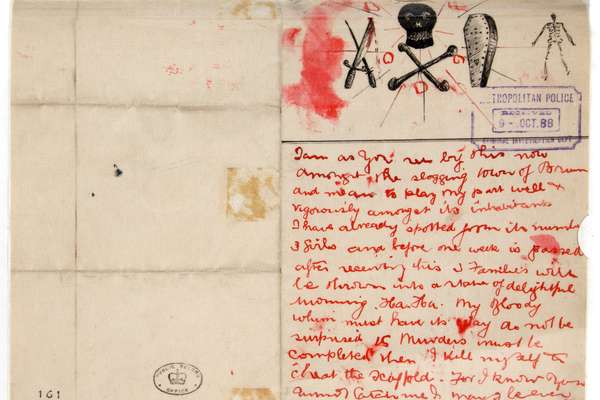
This is one of hundreds of letters in police files claiming to have been written by the infamous Whitechapel Murderer – otherwise known as 'Jack the Ripper'.
Division
Catalogue reference: Division within MEPO
Division within MEPO
Records of the Office of the Commissioner of the Metropolitan Police, concerning the maintenance of central criminal records and registers, and the organisation and duties of the force, including traffic matters.The main collection of...
Records of the Office of the Commissioner of the Metropolitan Police, concerning the maintenance of central criminal records and registers, and the organisation and duties of the force, including traffic matters.
The main collection of correspondence and papers is in MEPO 2, supplemented by MEPO 3. Letter books are in MEPO 1. Registers of habitual criminals are in MEPO 6, and registers of murders and deaths by violence in MEPO 20
Miscellaneous books and papers, including police service records, are in MEPO 4, records of police pensioners in MEPO 21, and of honours and awards to police officers in MEPO 22
Police orders are in MEPO 7, and confidential books and instructions in MEPO 8; representative records from various police units are in MEPO 11
Annual reports of the Commissioner are in MEPO 19; senior officers' papers in MEPO 10; and legal opinions in MEPO 23
Public information photographs are in MEPO 13, and photographs of police stations in MEPO 14
Registered files are in MEPO 26, MEPO 28, MEPO 31, MEPO 33 and MEPO 38
Minutes of the Advisory Committee on House to House Collections are in MEPO 40
The Metropolitan Police Office was until 1968 divided into two parts, the Office of the Commissioner and the Office of the Receiver. Until 1855 there were two commissioners of equal status, but eventually this arrangement proved unworkable and from that date there has been only one. His office was gradually divided into a number of administrative departments, each responsible for certain functions of the office and in some cases for the operation of certain executive subdepartments.
In 1909 there were four main administrative departments under assistant commissioners: A. Department for the administration and discipline of the force; B. Department for civil, financial and legal business and supervision of the Public Carriage Office and the Lost Property Office; C. Department for serious crime, supervision of the Criminal Investigation Department, the Special Branch and the Criminal Record Office, and business in connection with aliens and naturalisation; and D. Department for the enforcement of regulations governing matters such as street trading and traffic, street collections, betting and gaming, public morals and complaints against the police. During the First World War the traffic work of D was transferred to B, and in 1919 this became permanent, B Department becoming a more specialised Traffic Department. D Department disappeared; the rest of its work went to the department of the former chief clerk, who in 1918 was designated Secretary of the Metropolitan Police Office and in 1931 was given status equivalent to that of an assistant commissioner. This department came to be known as S Department.
In 1921 a new legal or L Department was set up to deal with much of the business formerly conducted by D Department. The new department also dealt with aliens, but its title was really a misnomer. Legal work for the Commissioner had been performed by a firm of private solicitors since 1887, and the Commissioner had no permanent legal adviser of his own until 1934, though there had earlier been one from 1874 to 1887. In 1931 L Department disappeared and its work was redistributed, though the new Solicitor's Department which developed after 1934 came in its turn to be known as L Department. In 1932 a new D Department, the Organisation and Recruiting (later Organisation and Training) Department, was established with responsibility for the organisation of the force. A, B, C and D Departments were primarily police departments, while L and S Departments remained purely civil departments. In 1953 a Research and Planning Branch (later Research and Development Branch) was set up under the direct control of the deputy commissioner.
The Metropolitan Police force has acquired certain functions appropriate to a central police authority, including the physical protection of the royal family and some ministers of the crown, the maintenance of central criminal records and the provision of professional advice and assistance, especially in the field of criminal investigation, to local police forces, though it has no authority over such forces.
Certain duties unrelated to the prevention and detection of crime have been assigned to the Commissioner of the Metropolitan Police by statute or by delegation from the Home Secretary. They include regulation and licensing of hackney cabs or taxis and public service vehicles, regulation of traffic, obstructions and street trading under the Metropolitan Streets Act 1867, and the registration and supervision of aliens. The office was formerly responsible for supervision of dangerous structures under the Metropolitan Buildings Act until 1869, when responsibility passed to the Metropolitan Board of Works, and for police and fire brigade services at certain military and naval establishments. In 1933 the licensing of public service vehicles was transferred to the Metropolitan Traffic Commissioners appointed by the Ministry of Transport. Most of these duties were discharged through specialist departments or sub-departments of the office.
In April 1968 the Deputy Commissioner became responsible to the Commissioner for the working of the police departments, the duties of which were modified to give D Department sole responsibility for police personnel and training matters. A Management services Department was formed incorporating the former Research and Development Branch and two new branches, Forward Planning and Organisation and Methods. L Department and the professional departments of the former Receiver's Office remained outside the two main groupings of departments.
In addition to the central administrative departments there were also specialised executive subdepartments or offices. They included specialised police branches, such as the Criminal Investigation Department, Special Branch, Fingerprint Department, Criminal Record Office, Metropolitan Police Laboratory, Training School and Police College, as well as civil offices such as the Aliens Registration Office, Lost Property Office, Public Carriage Office and Press Bureau (later Public Relations Department). Mixed civil and uniformed staff were employed in both types of office. In 1917, a Metropolitan Police Signals Intelligence Unit was established at Denmark Hill to intercept, decode and analyse wireless communications of use to the police. Discussions began about transferring the unit to the control of the Government Code and Cypher School in 1937, and the unit was transferred in November 1939, following the outbreak of war. There was also between 1959 and 1981 an ADP Unit, set up jointly with the Home Office and the Prison Commission to investigate computer applications for their work.
Records of the Metropolitan Police Office
Records of the Office of the Commissioner and successors
Record revealed
Focus on

Focus on
Records that share similar topics with this record.