Record revealed
Request for compensation for the Boston Tea Party
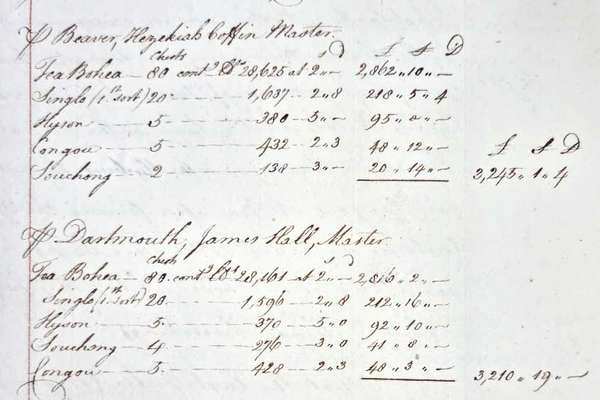
On 16 December 1773, 340 chests of tea were thrown into Boston harbour by protesting colonists. This letter from the East India Company requests reimbursement.
Series
Catalogue reference: IR 56
IR 56
This series consists of surviving nineteenth century files from the Board of Inland Revenue relating to stamp duty on newspapers.
This series consists of surviving nineteenth century files from the Board of Inland Revenue relating to stamp duty on newspapers.
They are arranged by date of registration under the reference given to them by the Secretaries' Office.
The stamp duty for newspapers was introduced by 10 Anne Cap 19 of 1711 at the rate of 1d. per full sheet and ½d. per half sheet. Its first effect was a drastic reduction in the number of publications of the day. The paper for printing newspapers had to be taken to the Stamp Office to have the duty stamp impressed upon it. Up to 1837 the only Stamp Office was in London, originally in Lincoln's Inn and latterly at Somerset House. It was for reasons of proximity to Somerset House that many of the printing houses were set up near at hand, mainly in or around Fleet Street. Newspaper offices in Scotland and the provinces were greatly inconvenienced in having their paper stamped in London and it became the practice for them to have their paper stamped through the agency of paper makers or paper agents who had their place of business in or near to London. To relieve this situation a Stamp Office was opened in Edinburgh in 1837 and later in the same year another office was opened in Manchester.
The stamps in multiples of 25 were impressed by hand from copper plates. Stamping by hand was at that time performed as quickly as by machinery, but eventually, with the growth of the newpapers, a new method was introduced. Edwin Hill, in charge of the Stamping Branch of the Board of Inland Revenue had, with his brother Rowland Hill, experimented some years earlier with a rotary steam press for newspapers. This was eventually improved upon and Edwin Hill suggested the incorporation of the newspaper stamp into the press which printed the newspapers. This arrangement was first adopted by The Timesin 1853 and later, in 1858, by the Illustrated London News. The Stamford Mercuryfollowed in 1859.
Before a newspaper could be printed or published its application to be established as such had to be approved by the Board of Inland Revenue with whom the newspaper was then registered. In 1855, however, the stamp duty on all newspapers was repealed and although some newspapers continued to be stamped after 1855 the stamp so impressed was in effect a payment of postage on copies for postal subscribers. The postal privileges for such stamped newspapers were abolished by the Income Tax Repeal Act of 1870. The newspaper stamp duty which commenced at 1d. in 1712 had risen to 4d. by 1815 but had fallen again to 1d. at the time of its repeal in 1855.
Board of Inland Revenue: Stamp Duty on Newspapers: Correspondence
Read stories that share a catalogue subject with this record.
Record revealed
Focus on
Record revealed
Records that share similar topics with this record.