Record revealed
Charter issued by the Anglo-Saxon King Edgar
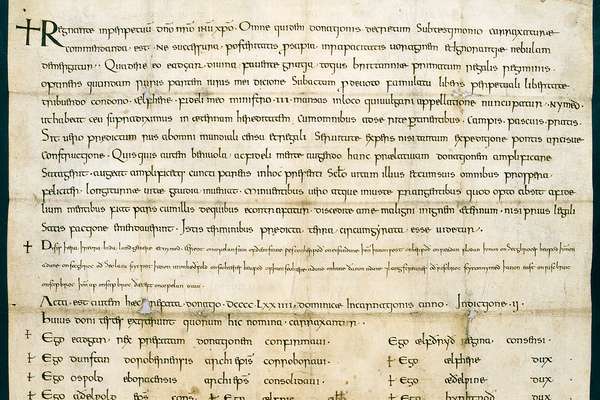
The oldest complete document at The National Archives, this charter recording a grant of land dates back over 1,000 years.
Series
Catalogue reference: HO 188
HO 188
Copies of warrants issued by the Home Secretary in exercise of the Royal Prerogative of mercy, granting pardon to a person wrongly convicted of a crime, commutation of a capital sentence to life imprisonment or a remission of a sentence imposed...
HO 188
1887-1960
Copies of warrants issued by the Home Secretary in exercise of the Royal Prerogative of mercy, granting pardon to a person wrongly convicted of a crime, commutation of a capital sentence to life imprisonment or a remission of a sentence imposed upon conviction.
Public Record(s)
English
14 files and volumes
Open
The constitutional basis for the duties of the Home Secretary in investigating and remedying the cases of persons wrongly convicted of criminal offences is the Crown's prerogative power of mercy. All prosecutions for criminal offences are taken in the name of the Sovereign and in consequence the Sovereign has power to pardon all offenders. This power derives from the Common Law and not from statute. An enactment during the reign of Henry VIII (27 Hen. 8. C. 24, 1) made it clear that the power of pardon was strictly reserved to the crown and the Remission of Penalties Act, 1859 extended it to all pecuniary penalties whether payable to the crown or not. Apart from these there is nothing in the statute law which materially affects the substance of the prerogative power.
By constitutional convention the Royal Prerogative is exercised on the advice of the Home Secretary who has a duty to recommend the exercise of the Prerogative to the Sovereign whenever he is satisfied that its use is warranted. The use of the Prerogative covers the whole range of criminal activity from the most trivial offences to capital crimes. When the Home Secretary is satisfied that the individual is innocent of the offence for which he or she was convicted, the exercise of the Prerogative usually takes the form of a Free Pardon which signifies that the conviction is to be disregarded and the person concerned freed of the consequences. Remission, which is generally used as an act of clemency or as a reward for assistance given to the authorities, mitigates or removes the consequences of a conviction by releasing the subject from having to serve some or all of a sentence of detention or having to pay some or all of a monetary penalty. During the period covered by these records the Prerogative also took the form of a conditional Pardon which was used to effect the commutation of a capital sentence to life imprisonment.
Records created or inherited by the Home Office, Ministry of Home Security, and related...
Home Office: Remissions and Pardons
Record revealed
Record revealed
Record revealed
Records that share similar topics with this record.