Focus on
The Huey Fong: Hong Kong's 1979 refugee crisis
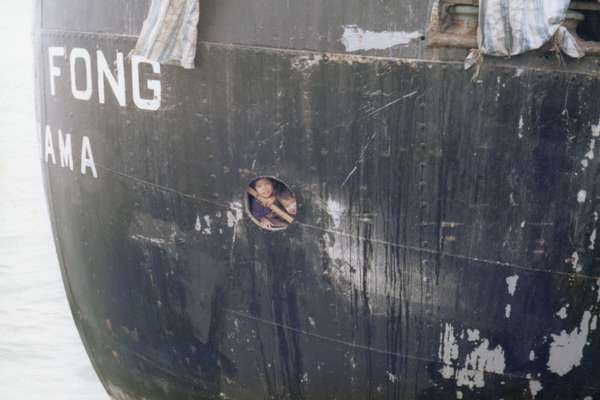
In December 1978, Vietnamese refugees seeking asylum aboard the Huey Fong were refused entry to Hong Kong. Records we hold document the 34-day standoff.
Series
Catalogue reference: FO 705
FO 705
This series contains private and semi-official correspondence of Sir Henry Pottinger, relating primarily to India and to his time in China, 1841-1844.
This series contains private and semi-official correspondence of Sir Henry Pottinger, relating primarily to India and to his time in China, 1841-1844.
For records of the Superintendent of Trade, China, see FO 677
Sir Henry Pottinger was born at Mount Pottinger Co. Down on 3rd October 1789, the fifth son of Eldreal Curwen Pottinger and Anne Gordon. He was educated at the Belfast Academy, but left to go to sea when he was 12 years old. Then in 1803 he went to India, as a cadet with the East India Co. In 1806 he became an ensign and on 16th July 1809 he was promoted to lieutenant.
In 1808 he accompanied a mission to Sind, and between 1809-1811 Pottinger and a friend explored large areas of India and Persia gathering information for the government. He was next appointed to the staff of Sir Evan Nepean, Governor of Bombay, who sent him to Mountstuart Elphinstone the British resident at Poona. While there he was promoted to Captain. On 1st May 1825 he became a major and soon after became resident at Cutch. He was promoted to Lt. Col. in 1829. While at Cutch he conducted a mission to Sind in 1831 and subsequently in 1836 he was appointed political agent there. In 1840 he returned to England because of ill health, and received a baronetcy.
Soon afterwards Pottinger accepted the post of envoy and plenipotentiary to China and superintendent of British trade. The opium war had broken out in 1840, and his predecessor had made one treaty but this had failed. Pottinger was expected to make a satisfactory treaty and re-open China to British trade. A considerable show of force was necessary however, and it was not until 29th August 1842 that a peace treaty was signed.
The terms included cession of Hong Kong to Britain and the five ports of Canton, Amoy, Foochow, Ningpo and Shanghai were opened to British trade. There was also to be consular representation. On 5th April 1843 he became the first British Governor of Hong Kong. He returned to England in the spring of 1844.
On 28th September 1846 Pottinger succeeded Sir Peregrine Maitland as Governor of the Cape of Good Hope, but only stayed there until on 4th August 1847 he became Governor of Madras. He remained in post in Madras until 1854 when ill-health again took him back to England. On 18th March 1856 he died in Malta.
He married in 1820 Susanna Maria, daughter of Captain Richard Cooke of Dublin.
Records created or inherited by the Foreign Office
Pottinger Papers
Read stories that share a catalogue subject with this record.
Focus on
Focus on
The story of
Records that share similar topics with this record.