Focus on
Smuggling gangs and coastal policing in 19th-century England
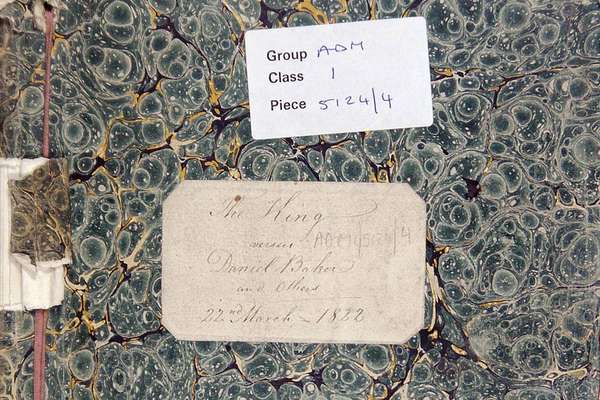
Following the Napoleonic Wars, smuggling became a major concern for the British government.
Division
Catalogue reference: Division within ADM
Division within ADM
Records of the Royal Naval Scientific ServiceReports of the Admiralty Centre for Scientific Information and Liaison are in ADM 213; and of the Board of Invention and Research in ADM 293Records of the Directorate of Aeronautical and Engineering...
Records of the Royal Naval Scientific Service
Reports of the Admiralty Centre for Scientific Information and Liaison are in ADM 213; and of the Board of Invention and Research in ADM 293
Records of the Directorate of Aeronautical and Engineering Research are in ADM 287; of the Directorate of Materials Research in ADM 278; of the Directorate of Operational Research in ADM 219; of the Directorate of Physical Research in ADM 285; of the Directorate of Research Programmes and Planning in ADM 282; and of the Scientific Research and Experiment Department in ADM 283
Papers of Dr A B Wood relating to his career in the scientific service are in ADM 218; and journals of the Royal Naval Scientific Service are in ADM 206
The Royal Navy had sponsored and carried out a good deal of scientific research in the nineteenth century, and a number of establishments such as HMS Vernon and the Admiralty Experiment Works had been set up, but the forerunner of the Royal Naval Scientific Service was the Board of Inventions and Research, established in 1915 to initiate, investigate and advise on proposals for the application of science and engineering to naval warfare, including inventions sent to the Admiralty by members of the public. In 1918 it became the Scientific Research and Experiment Department and in 1946 the Royal Naval Scientific Service.
Research and development in naval research establishments and externally to meet naval requirements were the responsibility of the third sea lord and controller of the Navy. Under him, supervision of research and development was carried out by an assistant controller research and development. A director of scientific research, first appointed in 1920, was head of the Scientific and Technical Services, responsible for scientific personnel and for formulating general policies with regard to research and development programmes. Under the assistant controller (R and D) he was responsible for co-ordination of all research and development work within the Admiralty and of this work with that of other organisations.
In 1946 the management of scientific research was reorganised by the establishment of four directorates within the Royal Naval Scientific Service (RNSS).
The Directorate of Research Programmes and Planning (DRPP) was responsible for the administration of scientific finance contracts not handled by the other directorates, patents, and technical records. In 1960 it became the Directorate of Research and Development Services.
The Directorate of Physical Research (DPR) supplied professional direction of physics and mathematics research. It was known later as the Directorate of Naval Physical Research.
The Directorate of Aeronautical and Engineering Research (DAER) managed research in aeronautics, engineering, chemistry and metallurgy. It changed its name several times: to the Directorate of Engineering and Materials Research (DEMR), the Directorate of Materials Research (DEMR), and the Directorate of Materials Research (Naval) (DMR(N)). DAER was responsible for the Admiralty Experimental Station, Welwyn from 1946 to 1951.
The Directorate of Operational Research (DOR) controlled operational analysts working to the vice chief of Naval staff. Its name changed to the Directorate of Operational Analysis (RN) (DOA(RN)), the Directorate of Naval Operational Studies (DNOS), then the Directorate of Naval Analysis (DNA).
With the formation of a unified Ministry of Defence in 1964 the RNSS was replaced by the Department of the Chief Scientist (Navy) and the constituent headquarters directorates gradually lost their separate identity.
The Technical Records Section was set up in 1929 for storage and distribution of technical information. It provided the basis for the Admiralty Centre for Scientific Information and Liaison (ACSIL) set up in 1947 for the purpose of receiving and disseminating reports on all research and development work of Naval interest, particularly those issued by Admiralty departments and establishments. It became the Naval Scientific and Technical Information Centre in 1964 and the Defence Research Information Centre in 1971.
Records of Royal Naval Scientific Service
Read stories that share a catalogue subject with this record.
Focus on
Record revealed
Record revealed
Records that share similar topics with this record.