Record revealed
Charter issued by the Anglo-Saxon King Edgar
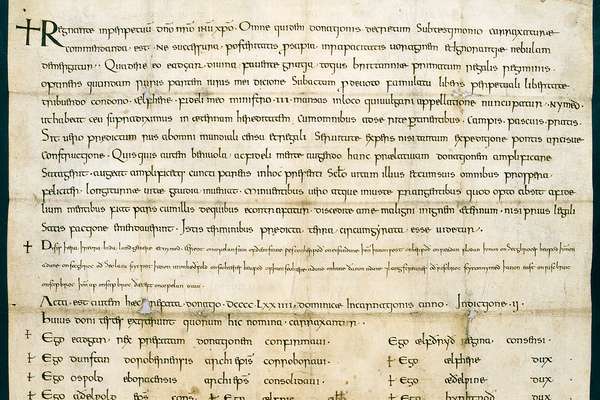
The oldest complete document at The National Archives, this charter recording a grant of land dates back over 1,000 years.
Series
Catalogue reference: E 31
E 31
This series contains the oldest of the public records, the two volumes which comprise Domesday Book, which were formerly in the Exchequer Treasury of Receipt. The larger, Great Domesday, is the digest of the survey ordered by William I at...
This series contains the oldest of the public records, the two volumes which comprise Domesday Book, which were formerly in the Exchequer Treasury of Receipt.
The larger, Great Domesday, is the digest of the survey ordered by William I at Gloucester at Christmas 1085. Little Domesday is the draft, uncondensed survey for Norfolk, Suffolk, and Essex. Together the two volumes cover the whole of England except for Northumberland and County Durham; parts of Cumberland, Westmorland and Lancashire are also omitted.
Domesday Book is a fiscal inventory noting taxable values; a feudal statement revealing the structure of estates within each county; and a legal record establishing which tenant rightfully held estates.
Other pieces in the series are the chest in which the books are thought to have been kept in the seventeenth and early eighteenth centuries; Tudor and later covers removed during the several re-bindings of the volumes; and a tracing made by Abraham Farley of one of the Surrey folios.
Please note: Digital copies of these records can be downloaded.
The book, known at first as the 'Book of Winchester' after the treasury in which it was originally housed for safe-keeping, had acquired its modern name by the twelfth century. 'Domesday', which may be interpreted as the day of judgment, was a recognition that its evidence was subject to no appeal. Domesday Book is the end-product of a general survey of England ordered at Christmas 1085 by William the Conqueror. Contemporary sources do not explain precisely why he wanted it made, but he clearly felt a pressing need to possess a detailed inventory of the lands and resources of the kingdom which he had acquired by right of conquest nineteen years earlier, in 1066.
The necessary inquiries were carried out by groups of commissioners by means of sworn inquests in the county or hundred courts. The Cambridge returns are particularly important, for they include a list of the questions asked: What is the manor called? Who held it in the time of King Edward? Who holds it now? How many hides? How many ploughs on the demesne? How many men? How many villeins? How many cottars? How many slaves? How many free men? How many socmen? How much wood? How much meadow? How much pasture? How many mills? How many fishponds? How much has been added or taken away? How much, taken together, was it worth and how much now? How much each free man had or has. All this at three dates, to wit, in the time of King Edward and when King William gave it and as it is now. And if it is possible for more to be had than is had.
The information obtained was cross-checked and then, after some recasting locally into returns covering circuits - that is, groups of counties - was sent to Winchester, probably during the second half of 1086. There, a single scribe, under the supervision of the anonymous royal official who master-minded the project, was set to work to summarise all the material into its final form, producing the book now known as Great Domesday. His work was halted before his task was complete, possibly because of the death of William in September 1087. At that stage the circuit return covering Essex, Norfolk and Suffolk had yet to be condensed, and this undigested return was separately preserved as part of the final record, forming the volume known as Little Domesday. It has, however, recently been suggested that the book was compiled from the returns of 1086 in the reign of William II, in or after 1089, for reasons different from those for which the survey was originally undertaken.
Exchequer: Treasury of the Receipt: Domesday Book etc
Read stories that share a catalogue subject with this record.
Record revealed
Record revealed
Focus on
Records that share similar topics with this record.