Record revealed
Japanese Instrument of Surrender, 1945
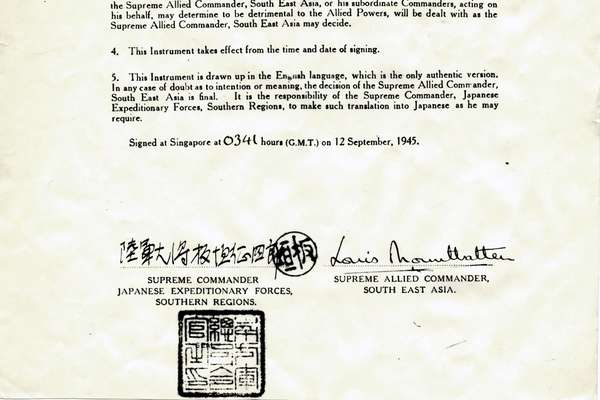
After six years of brutal global conflict, this document marked the end of the Second World War.
Series
Catalogue reference: DEFE 3
DEFE 3
File copies of teleprinter messages. The various series of messages are of two distinct types: intercepted signals, decrypted, translated, and sent from the German Naval Section of the Admiralty's Naval Intelligence Division at Bletchley Park to...
File copies of teleprinter messages. The various series of messages are of two distinct types: intercepted signals, decrypted, translated, and sent from the German Naval Section of the Admiralty's Naval Intelligence Division at Bletchley Park to the division's Operational Intelligence Centre in the Admiralty; and summaries of intelligence derived from such signals sent to the War Office, Air Ministry and overseas commands. These signals became known as ULTRA.
Records within this series are available to download as digital microfilm.
The files were bound in order of the German time of origin (in some cases upwards from the bottom of the file), irrespective of the time and date of decrypting, the cipher employed (which is rarely indicated), or the area, type of vessel, or significance of the signal. The copies that compose this series follow the same arrangement.
Records relating to signals intelligence passed to the Prime Minister from the Government Code and Cypher School during the Second World War are in HW 1
Records about the administrative arrangements for Hut 3 at Bletchley Park can be found in the Hut 3 directives (pieces 126-127 include appreciations of work on ULTRA by senior military commanders, including Eisenhower) in:: HW 3/124 HW 3/125 HW 3/126 HW 3/127
Summaries of tactical signals intelligence forwarded to allied commands by the Government Code and Cypher School are in HW 20
The station and allied forces codes for transmission of material decoded are contained in HW 3/165
Another file of ULTRA material, relating to the sinking of the SCHARNHORST along with reports of the ULTRA Representatives with US Army Groups is in ADM 223/36
Reports are in PRO 31/20
from 1977 Ministry of Defence
During the war of 1939-1945, radio messages transmitted by the German, Italian and Japanese armed forces were, whenever possible ciphered, intercepted by allied radio operators. Ciphered messages intercepted by British radio stations were decrypted at the Government Code and Cipher School at Bletchley Park in Buckinghamshire ('B.P' or 'Station X'), and then sent to the intelligence staffs of operational forces at home and overseas.
The German armed forces made extensive use of an electrical keyboard (the Enigma machine) which produced an extremely complex and easily varied means of enciphering and deciphering signals; the system was thought to be secure for all practical purposes, and was in constant use for important communications throughout the war. Bletchley Park, however had an Enigma machine acquired just before the war, and further machines with current settings were captured from time to time. With the aid of these and of computers which they were developing independently, the British cryptanalysts were able to read a high proportion of enemy signals enciphered in this way. In order to preserve the secret that the cipher could be broken, intelligence derived from Enigma signals was given a special security classification, MSS (Most Secret Source) or Ultra, and disguised as having come from agents in enemy territory, or from prisoners of war.
Admiralty: Operational Intelligence Centre: Intelligence from Intercepted German, Italian and Japanese Radio Communications, WWII
Read stories that share a catalogue subject with this record.
Record revealed
Focus on

Focus on
Records that share similar topics with this record.