-
Reference
(The unique identifier to the record described, used to order and refer to it)
-
CP 61
-
Title
(The name of the record)
-
Court of Common Pleas: Concordia Pedum Finium Files
-
Date
(When the record was created)
-
1562-1678
-
Description
(What the record is about)
-
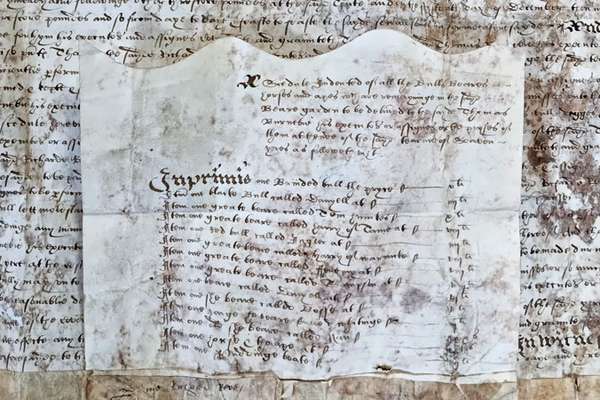
This series consists of original files of writs of dedimus potestatem issued by the Court of Common Pleas in the name of English and British monarchs.
These writs, essentially orders, were addressed to the justices and other officials of the English courts, commissioning them to collect the acknowledgements of the defendants (or deforciants) unable to travel to Westminster, one of the parties in collusive suits pending before the court which were intended to end in a final concord settling the supposed dispute. The writs were then returned by the justices endorsed with their answer and the term in which a proclamation was made.
The proclamation was a public announcement made in court to declare the end of the case and to detail the terms of the final concord. These proclamations provided validity to the final concord. Although there might be multiple terms in which a proclamation could be made, the writs were filed by the first term of proclamation.
The formulae of the dedimus potestatem writs are well known and easily ascertained from formularies and accounts of court practice.
These documents give the names of the parties involved in the suits (plaintiffs or buyers and defendants or sellers) and also detail the properties in question. In many cases, the dorses of the writs are blank and the acknowledgements are on other pieces of parchment attached to the writ. The endorsed or attached acknowledgements were to be used as part of the text of the final concords. These also often include the signatures of the officials or of the deforciants, and the proclamation term by which the writs were collected by the filazers.
The files were wrapped in a parchment cover labelled with the legal term and the regnal year.
Until the reign of Elizabeth I these writs were part of the Brevia files in CP 52, filed at the beginning of the first return day for each legal term and described as ‘letters to the justices’.
The earliest original file identified in this series is from Hilary term, 4 Elizabeth I (1562) and the latest, CP 61/57, from Hilary term, 29/30 Charles II (1678).
In the 19th century some of the files were dismantled and accessioned by monarch. These are now in series CP 24/1 to CP 24/13 . Links and gaps between these series are noted at piece level.
The files included in CP 61 were identified at a later stage.
The records are in Latin, except between Trinity 1651 and Trinity 1660 when they are in English.
-
Arrangement
(Information about the filing sequence or logical order of the record)
-
The references use a simple running number scheme, from CP 61/1 to CP 61/65.
The files are arranged chronologically within the series until piece 57. Pieces 58 to 65 include material from the reigns of Elizabeth I and James I that has been found since the completion of the preliminary sorting process.
The series is still accruing, as more material is likely to be identified in future sorts and will be added at the end of the piece sequence
-
Related material
(A cross-reference to other related records)
-
Final concords or feet of fines files can be found in
CP 25/1
Notes of feet of fines files can be found in
CP 26/1
and
CP 25/2
Portions of broken writs of covenant can be found in
CP 50
to
CP 26/14
Dedimus potestatem writs for suit initiated before 1558 can be found in
CP 52
Writs of covenant initiating the suits can be found in
CP 55
-
Separated material
(A cross-reference between records that are related by provenance but now kept separately)
-
Files accessioned by monarch are in the range between the two references below:
CP 24/1
CP 24/13
-
Held by
(Who holds the record)
-
The National Archives, Kew
-
Legal status
(A note as to whether the record being described is a Public Record or not)
-
Public Record(s)
-
Language
(The language of the record)
-
English and Latin
-
Access conditions
(Information on conditions that restrict or affect access to the record)
-
Open
-
Subjects
(Categories and themes found in our collection (our subject list is under development, and some records may have no subjects or fewer than expected))
-
- Topics
-
Conveyancing
-
Litigation
-
Record URL
-
https://beta.nationalarchives.gov.uk/catalogue/id/C5438/