Record revealed
Japanese Instrument of Surrender, 1945
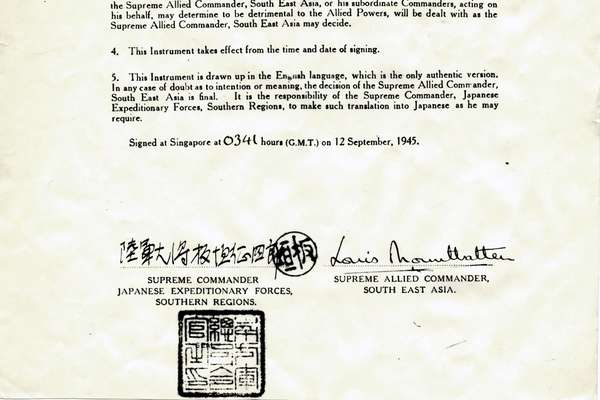
After six years of brutal global conflict, this document marked the end of the Second World War.
Division
Catalogue reference: Division within WO
Division within WO
Records of the Royal Chelsea and Kilmainham Hospitals relating to hospital for disabled soldiers. Comprises records of the Royal Chelsea Hospital: Administrative records of the Chelsea hospital, WO 245 to WO 248, WO 250 and WO 251Invaliding Board...
Records of the Royal Chelsea and Kilmainham Hospitals relating to hospital for disabled soldiers.
Comprises records of the Royal Chelsea Hospital:
Comprises records of the Kilmainham Hospital:
See also DEFE 158
For records relating to pensions see PMG 8
By letters patent of 22 December 1681 Charles II initiated plans for a permanent hospital for old, lame and infirm soldiers, and appointed the paymaster general of the forces as receiver general and treasurer of the monies raised for the erection and maintenance of the hospital. In February 1680 land for the hospital was acquired at Chelsea and money for its upkeep was provided by royal warrant in 1683 and 1684. Provision was made in 1686 for the payment of pensions to disabled and unfit soldiers. The building was completed in 1690 and a board of three commissioners was appointed by letters patent of 3 March 1692. The first pensioners were admitted in that year. In the 1750's regulations were passed to make length of service the principal reason for award of pensions, not disability.
Originally it was intended to house all Army pensioners there, but the accommodation proved to be inadequate and a system of out-pensions was also devised. Out-pensioners soon greatly outnumbered in-pensioners. Besides their pensions functions, the commissioners of Chelsea Hospital have since the beginning of the nineteenth century been responsible for the distribution of Army prize money.
Similar functions with regard to pensioners on the Irish establishment were performed by the Royal Hospital at Kilmainham, founded in 1679, for which the first commissioners were appointed in 1684. From 1698 it also operated a system of out-pensions until in December 1822 its out-pensioners were transferred, as out-pensioners, to Chelsea Hospital. After southern Ireland became independent in 1922 no new in-pensioners were accepted at Kilmainham and those remaining were transferred to Chelsea or to out-pension in 1929.
The commissioners of the two hospitals did not handle all military pensions. Except for a few officers admitted as in-pensioners, they were not concerned with officers' pensions. Officers generally retired on half-pay, and this was used as a for of pension. The Board of Ordnance was responsible for payment of pensions to Ordnance troops until 1833, when the Ordnance pensioners were transferred as out-pensioners to Chelsea Hospital.
From 1708 there was also provision for pensions payable to widows of officers killed in action, (including from 1818 'Drouly Annuities' payable to fifteen poor widows of captains, lieutenants and ensigns), to their children (payable from the Compassionate Fund), and to their dependent relatives (payable from the Royal Bounty). Pensions for wounds were introduced in 1812 and a very few officers - mainly those who raised invalid or veteran battalions - were entitled to full retired pay.
The office of receiver or paymaster and treasurer to Chelsea Hospital was generally combined with that of paymaster general of the forces until in 1835 both were merged with the corresponding Navy and Ordnance offices in a single office of paymaster general; who thereafter acted as paymaster for all service pay and pensions, except for war pensions arising from the First and Second World Wars, which were made the responsibility of the Ministry of Pensions and the Ministry of Pensions and National Insurance.
Records of the Royal Chelsea and Kilmainham Hospitals
Read stories that share a catalogue subject with this record.
Record revealed
The story of
Focus on
Records that share similar topics with this record.