The story of
Britain’s youngest prisoner of war: John Giles Hipkin
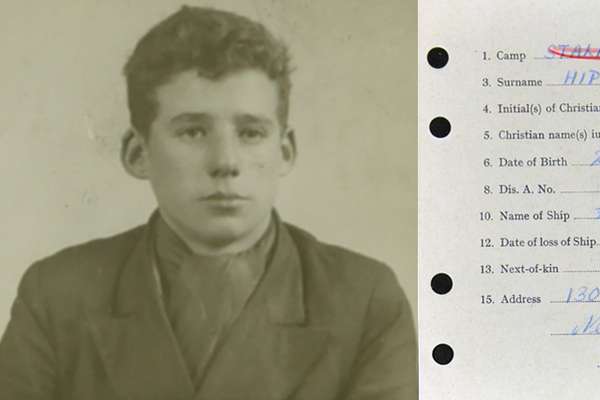
14-year-old cabin boy John Giles Hipkin became Britain's youngest Second World War prisoner of war in 1941 after he was captured at sea.
Division
Catalogue reference: Division within HO
Division within HO
Records of the Probation and After-Care Department and its predecessors. Files concerning probation are in HO 330; files concerning the after-care of offenders are in HO 247 and HO 383; Borstal Institutions registers HO 260. Release on License...
Records of the Probation and After-Care Department and its predecessors.
Files concerning probation are in HO 330; files concerning the after-care of offenders are in HO 247 and HO 383; Borstal Institutions registers HO 260.
Release on License (ROL symbol series) are in HO 529.
Probation Inspectorate (PI Series) are in HO 560
Probation Directorate (PN Series) are in HO 561
The modern probation system developed from the practice whereby courts took recognizances for good behaviour as an alternative to sentencing offenders to terms of detention. The practice was reinforced by the probation provisions of the Summary Jurisdiction Act 1879 and the Probation of First Offenders Act 1877. However, no formal machinery existed for the supervision of probationers to ensure compliance with the conditions laid down in the recognizances, although some courts used 'court missionaries' provided by voluntary societies for this purpose. The Probation of Offenders Act 1907 gave a statutory basis to such arrangements. It permitted magistrates courts to appoint paid probation officers as officers of the court to supervise the conduct of offenders committed to their care, and to advise and befriend them. The Criminal Justice Act 1925 made appointment of probation officers mandatory. Later acts such as the Criminal Justice Act 1948 have rationalised and consolidated probation provisions.
The Secretary of State for Home Affairs has been responsible for the probation service since its inception in 1907, and rules governing the appointment, dismissal and duties of probation officers are issued by the Home Office.
Until 1936 this responsibility was exercised by officers of the Children's Branch. Its inspectors visited local centres to review probation arrangements but for the most part relied on reports forwarded by local probation committees. These committees were appointed by each magistrates court or by groups of courts combining to form a larger probation area. They were responsible for the local administration of the probation service, in conjunction with Case Committees which monitored progress in individual cases. The Home Office was represented on the London Probation Committee, and was more directly involved in probation services in the London area.
In 1936 the administration of probation passed to the new Probation Branch of the Home Office. Its inspectors became more actively involved in the recruitment and training of probation officers, in the supervision of their work, and in the preparation of detailed guidelines on all aspects of probation work. This followed developments such as the requirement from 1926 for confirmation by the Home Secretary of all appointments of probation officers, and the start of a training scheme in 1930.
The Probation Branch became the Probation Division in 1943. In the 1960s its title changed to the Criminal and Probation Department then to the Probation and After-Care Department. With reorganisation of the Home Office in 1982 it became C6 Division of the Criminal Justice Department, responsible for all probation and after-care services in England and Wales.
The changes of title reflected the extension of the probation service to include after-care of offenders when they had completed their term of probation or imprisonment. As well as supervising offenders committed to their care by the courts, and reporting back on their progress, probation officers undertake investigations for the courts: of home circumstances, including financial means, to assist courts in sentencing, in custody and adoption matters, and in maintenance orders. They conciliate in matrimonial disputes taken to court. They also inspect hostels, day centres and other facilities provided for offenders.
The Home Office is advised on the administration of the probation service and the training of probation officers by the Probation Advisory and Training Board. This body was set up in 1949 through the amalgamation of the Probation Advisory Committee (set up in 1924) and the Probation Training Board (set up in 1937). These bodies contained representatives of the magistracy, the Home Office, and other qualified people.
Probation and After-Care Department and predecessors
Read stories that share a catalogue subject with this record.
The story of
Record revealed
Record revealed
Records that share similar topics with this record.