Record revealed
A dramatic plea for Churchill’s help from Bletchley Park
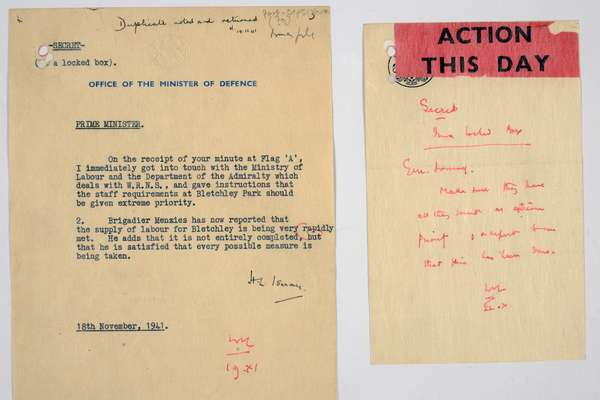
In 1941, four Government Code and Cypher School cryptanalysts, including Alan Turing, made a stunning appeal directly to Winston Churchill.
Division
Catalogue reference: Division within BT
Division within BT
Records of the Ministry of Materials relating to procurement of raw materials.Registered files of the ministry are in BT 161. Private office papers of the first Minister of Materials are in BT 172.
Records of the Ministry of Materials relating to procurement of raw materials.
Registered files of the ministry are in BT 161. Private office papers of the first Minister of Materials are in BT 172.
The Cabinet file on the formation and functions of the Ministry of Materials is in
Treasury Solicitor files relating to the Ministry of Materials, including its establishment and dissolution, are in TS 63 CAB 21/2271
Some further records of the Ministry of Materials are in
The Ministry of Materials was established as the result of international economic conditions which seemed likely to make the procurement of raw materials very difficult for some considerable time. After the Second World War such controls as remained on raw materials were exercised by the Board of Trade, the Ministry of Fuel and Power, and the Ministry of Supply.
The outbreak of the Korean War in 1950 so changed the economic and political situation that the government became convinced that it was necessary to establish a separate organisation with responsibility for the supply of raw materials. At first a Cabinet minister, the Lord Privy Seal, was given special responsibility for watching over their supply; then in July 1951, while retaining his original post, he was appointed minister of materials and provided with a new department.
The Ministry of Materials had general responsibility for the supply of raw materials up to the point at which they entered into manufacturing industry. Its power in this field was not complete. The Ministry of Supply remained the central authority concerned with iron and steel and certain other metals, although responsibility for most non-ferrous and light metals in unwrought forms, including ores and concentrates, passed from it to the Ministry of Materials. All the Board of Trade's concern with raw materials, save its responsibility for some chemicals, diamonds, and tobacco, passed to the new ministry, and the board's powers with respect to the Raw Cotton Commission were likewise transferred.
Soon after the ministry had been set up, the world trading position began to improve. Controls on raw materials were gradually removed, and by the end of 1953 private trading had been resumed in almost all the materials which had come within its power. The reason for its separate existence having disappeared, it was disbanded in August 1954, and its remaining functions were transferred to the Board of Trade.
Records of the Ministry of Materials
Read stories that share a catalogue subject with this record.
Record revealed
Records that share similar topics with this record.