Record revealed
Hoax letter signed by ‘Jack the Ripper’
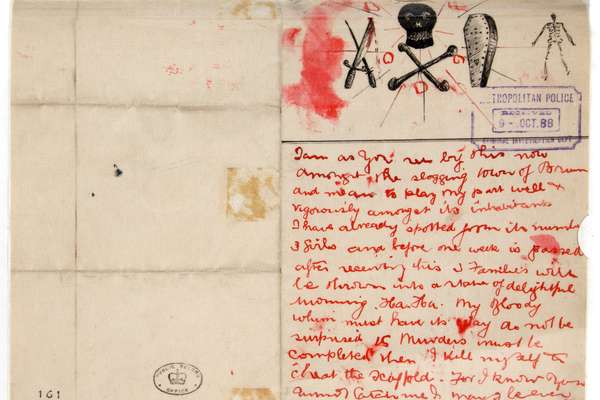
This is one of hundreds of letters in police files claiming to have been written by the infamous Whitechapel Murderer – otherwise known as 'Jack the Ripper'.
Series
Catalogue reference: CHES 17
CHES 17
This series consists mainly of the few surviving records of local judicial visitations conducted by the justice of Chester. They can be divided into three sections.Firstly there is a broken series of plea rolls recording proceedings at such eyres...
This series consists mainly of the few surviving records of local judicial visitations conducted by the justice of Chester. They can be divided into three sections.
Firstly there is a broken series of plea rolls recording proceedings at such eyres before a number of justices of Chester between 1307 and 1455. The rolls consist mainly of records of civil and crown pleas. The civil pleas seem, from the contents of the rolls, mainly to have been plaints initiated by bills, not writs. They could be continued in the county court if not concluded in eyre, and if not concluded there could return to the eyre court again. Indictments for criminal offences were made locally by juries and then transferred to the county court at Chester for subsequent process. The rolls often include separate sections for records of warrants of attorney.
Secondly there is a series of distinct rolls for Macclesfield eyres, mostly for the period between 1337 and 1384, but including an important roll for the period from 1285 to 1290. Macclesfield eyres for the end of Edward I's reign and the beginning of Edward II's are also recorded in one of the general rolls. Some of the Macclesfield eyre rolls include gaol delivery sections, and one is as much a file as a roll, including jury panels, inquisitions etc, as well as the enrolled record of pleas.
Thirdly there are records relating to an eyre held in the palatinate by Arthur prince of Wales in 1499. These comprise the plea roll of the eyre, some drafts on paper of material for it, and an Elizabethan record of a quo warranto plea heard during it.
For surviving records of general eyres, see JUST 1
Coroners' inquest files can be found in JUST 2
Local judicial visitations were conducted by the justice of Chester, the senior official and judge of the palatinate, and in theory at least took place annually at a number of different venues for the various areas of the county. They were called an eyre ('iter'), although their nature was somewhat different from the general eyres held periodically throughout the rest of England in the late twelfth and thirteenth centuries. Such eyres were not held in Cheshire, although in 1353 Edward prince of Wales, son and heir of Edward III, tried to hold one but allowed it to be bought off and replaced it with a trailbaston commission.
The most usual venues recorded for the eyres of the justice of Chester, or of justices appointed in his place for 'this turn' (hac vice), were Backford, for Wirral; Christleton, for Broxton hundred; Taporley, for Eddisbury hundred; Middlewich, for Bucklow and Northwich hundreds; and Nantwich, for Nantwich hundred. The eyres usually, in the fifteenth century at least, took place about a week after a county court session.
Macclesfield manor and hundred had special arrangements. From 1270 to 1290 it was in the possession of Edward I's queen, Eleanor of Castile, and for much of the period from 1309 to 1347 in the hands of Edward II's consort Isabella, which effectively made the whole hundred a privileged liberty within the county, to the exclusion of local officials (on one occasion, in 1288, Hugh de Cressingham, Queen Eleanor's steward, sat jointly with the justice of Chester). Equivalent eyres in Macclesfield were therefore of a rather different nature, and they included the hearing of forest pleas for Macclesfield forest.
Palatinate of Chester: Eyre Rolls
Read stories that share a catalogue subject with this record.
Record revealed
Focus on

The story of
Records that share similar topics with this record.