Record revealed
Report on the British Indian Army, 1943
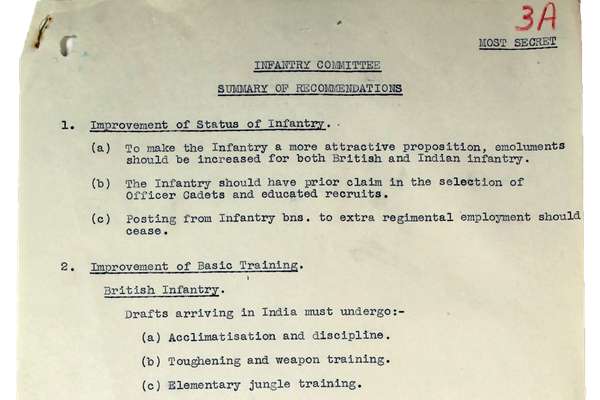
This Second World War War Office document assessed the British Indian Army's battle readiness and made recommendations for its development.
Series
Catalogue reference: CAB 88
CAB 88
This series consists of minutes and memoranda of the Combined Chiefs of Staff Committee and Sub-committees.
This series consists of minutes and memoranda of the Combined Chiefs of Staff Committee and Sub-committees.
Subject and chronological
From 1970 Cabinet Office
The Combined Chiefs of Staff Committee was brought into formal existence in February 1942, and continued until the end of the Second World War. It was composed of the US Joint Chiefs of Staff and the British Chiefs of Staff, and was created following agreement between the British Prime Minister (Winston Churchill) and the US President (F D Roosevelt) at the first Anglo-American conference held after the US entry into the war (the Washington War Conference (Arcadia), December 1941 to January 1942).
The responsibilities of the Combined Chiefs of Staff were set out as follows [see CAB 79/20]: Under the direction of the heads of the United Nations, the Combined Chiefs of Staff will collaborate in the formulation and execution of policies and plans concerning: (a) the strategic conduct of the war; (b) the broad programme of war requirements based on approved strategic policy; (c) the direction of munition resources based on strategic needs and the availability of means of transportation; and (d) the requirements for overseas transportation for the fighting services of the United Nations, based on approved strategic priority. In the report of the Arcadia Conference [CAB 99/17], it is noted, to avoid confusion, that the word 'Combined' applied to the Combined Staffs of, or combined action by two or more of the united nations, whilst the word 'Joint' signified inter- service planning by one of the 'united nations.'
The Combined Chiefs were based in Washington, where the routine and general meetings were usually held in the intervals between conferences. If the British Chiefs of Staff (who were based in London) were unable to attend these meetings in person, they were represented by the head of the British Joint Staff Mission (responsible to the British Chiefs of Staff Committee) and the heads of the three Service delegations who constituted the Mission. The British Chiefs of Staff took their place on the Combined Chiefs of Staff Committee at the international conferences (at which Roosevelt and Churchill settled the main lines of allied strategy). For the conferences at Tehran (December 1943), Yalta (February 1945) and Potsdam (July-August 1945), the British and Americans were joined by the Russian Chiefs of Staff.
The existence of the Combined Chiefs of Staff enabled forces to be effectively placed under a commander of a different nationality without breaking the chain of responsibility to their home government, as commanders were responsible to the Combined Chiefs who respectively continued to remain responsible to their own governments. This responsibility was both advisory (in terms of the settlement between governments of the overall strategy) and executive (in terms of formulating and issuing directives to implement that strategy).
The Combined Chiefs of Staff were equipped with a supporting organisation of combined committees and sub-committees to deal with specific subjects. Of these, the Combined Planning Staff were the body of officers appointed by the Combined Chiefs of Staff to make studies, draft plans, and perform such other work as placed on the Combined Chiefs of Staff agenda and delegated to them by the Combined Planning Staff. Officers attached to the British Joint Staff Mission provided the British element in the secretariat for these combined committees. Their authority did not extend to operations controlled directly by the Admiralty and the US Navy Department.
War Cabinet and Cabinet: Combined Chiefs of Staff Committee and Sub- committees: Minutes and Memoranda (CCS and other Series)
Read stories that share a catalogue subject with this record.
Record revealed
Record revealed
Records that share similar topics with this record.