Focus on
Olga Gray and the Woolwich Arsenal Spy Ring

In 1938, thanks to years of work by a remarkable female agent, MI5 ensured a package of British defence plans stayed secret.
Series
Catalogue reference: CAB 82
CAB 82
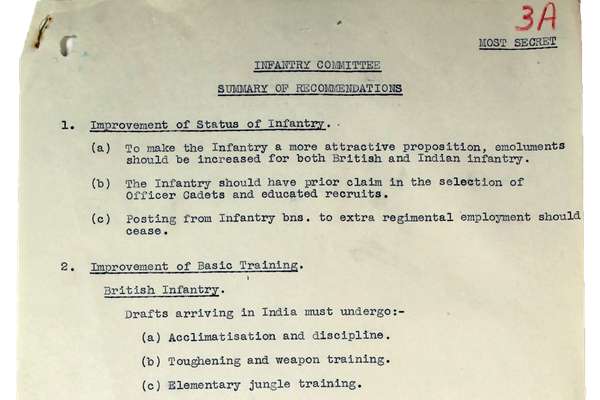
This series consists of minutes and papers of the Deputy Chiefs of Staff Committee and its various sub-committees, covering a variety of subjects such active air defence, inter-service training, vulnerable points, defence services, police forces,...
This series consists of minutes and papers of the Deputy Chiefs of Staff Committee and its various sub-committees, covering a variety of subjects such active air defence, inter-service training, vulnerable points, defence services, police forces, atomic weapons, defence research policy, and petroleum fuels policy.
Subject and chronological
From 1970 Cabinet Office
At the outbreak of the Second World War, the Deputy Chiefs of Staff Committee existed as a subordinate body to the Chiefs of Staff (COS) Committee. In April 1940, prompted by increasing pressure on the time and energy of the COS Committee, the government appointed the three Vice-Chiefs of Staff to act as substitutes for their own Chiefs, and whose thrice-weekly meetings counted equally as meetings of the COS Committee. The creation of this Vice-Chiefs of Staff Committee, together with the fact that the post of Deputy Chief of Staff no longer existed in the Admiralty or the War Office, caused the Deputy Chiefs of Staff to cease to function, and at their meeting on 16 August 1940, the COS Committee agreed that the Deputy Chiefs of Staff Committee should be abolished, it having last met on 8 August 1940.
In April 1945, the COS Committee, with the approval of the Lord President of the Council, directed that the Joint Committee on Research and Development Priorities should be reconstituted with the title of the Deputy Chiefs of Staff Committee [see DCOS(45)1 in CAB 82/6 for terms of reference and composition]. The reconstituted Deputy Chiefs of Staff Committee met from 25 April 1945 to 31 December 1946 (63 meetings), chaired to January 1946 by Admiral Sir Charles Kennedy-Purvis (Deputy First Sea Lord), and from February 1946 by Lt General Sir Sidney Kirkman (Deputy Chief of the Imperial General Staff).
From 1947, the Deputy Chiefs of Staff Committee was superseded by the Defence Research Policy Committee, with some technical questions which demanded inter-service consultation being dealt with by a reconstituted Joint Technical Warfare Committee.
The main sub-committee of the Deputy Chiefs of Staff Committee was the Sub-committee on the Allocation of Active Air Defences, which was set-up in December 1939, to be chaired by the Director of Operations of the Air Ministry, with representatives from the Admiralty and the War Office. The Sub-committee was established to consider applications, make recommendations, and suggest methods for active air defence, to point out the effects of such recommendations on existing programmes, and to put forward specific proposals for additions to approved programmes. The Sub-committee reported to the Deputy Chiefs of Staff Committee until its abolition in August 1940; thereafter it reported directly to the main COS Committee.
War Cabinet and Cabinet: Deputy Chiefs of Staff Committee and Sub- committees: Minutes and Papers (DCOS and other Series)
Read stories that share a catalogue subject with this record.
Focus on
Record revealed
Record revealed
Records that share similar topics with this record.