Record revealed
Charter issued by the Anglo-Saxon King Edgar
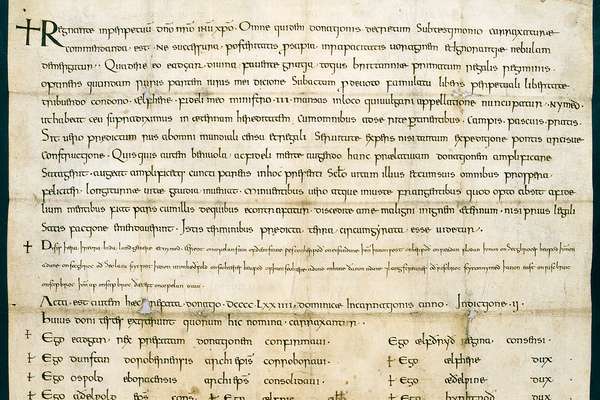
The oldest complete document at The National Archives, this charter recording a grant of land dates back over 1,000 years.
Series
Catalogue reference: C 134
C 134
The third series of inquisitions post mortem in Series I, dating to the reign of Edward II.
The third series of inquisitions post mortem in Series I, dating to the reign of Edward II.
Each file is usually made up of the documentation of inquisitions post mortem following the deaths of about twenty persons. The actual number of inquisitions in each file is likely to be rather greater than twenty, given that a tenant might well have held lands in more than one county, in which case separate inquisitions were required to be conducted in each shire concerned. The series is arranged, as far as possible, in chronological order.
Inquisitions made upon the lands of particularly wealthy magnates, such as Gilbert de Clare, earl of Gloucester (1291-1314), take up several files on their own.
Accounts submitted to the Exchequer by the escheators are in E 136
Copies of inquisitions post mortem sent to the Exchequer are in
From 1323 there was no escheator south of the Trent, likewise north of the Trent from 1324, and for the last few years of Edward II's reign Chancery dealt directly with the local escheators, or, in certain instances, sent writs to conduct inquisitions to named individuals, some of whom, at least, were justices.
Responsibility for escheats in Wales and Ireland was in the hands of local justices or escheators, and was largely separate from the administration in England.
Examples of types of writ which seem to make their first appearance during Edward II's reign include amotus - 'removed' - which was required for those cases where the term of office of an escheator had expired before he had been able to execute the original writ; dedimus potestatem - 'we have given power' - authorizing an officer or another individual either to receive attorneys (commonly appointed by women to act on their behalf at assignments of dower, partitions and court hearings) or to take oaths sworn by widows to the effect that they would not remarry without the king's licence; and (ad manus nostras) devenerunt - 'they have come (into our hands)' - used to authorized a new inquisition when an heir or heiress died while his or her inheritance was still in wardship.
Records created, acquired, and inherited by Chancery, and also of the Wardrobe, Royal...
Chancery: Inquisitions Post Mortem, Series I, Edward II
Record revealed
Records that share similar topics with this record.