Record revealed
Charter issued by the Anglo-Saxon King Edgar
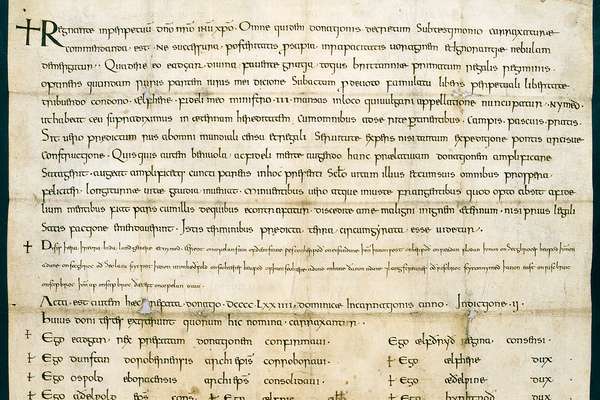
The oldest complete document at The National Archives, this charter recording a grant of land dates back over 1,000 years.
Series
Catalogue reference: C 133
C 133
In addition to the inquisitions post mortem and their related writs, this series contains the earliest examples of proofs of age, hearings at which jurors gave testimony as to the date of birth of a ward who claimed, or was thought to have...
In addition to the inquisitions post mortem and their related writs, this series contains the earliest examples of proofs of age, hearings at which jurors gave testimony as to the date of birth of a ward who claimed, or was thought to have reached, full age at which they could inherit.
The series also includes a limited amount of material relating to inquisitions held in Scotland during periods of English occupation, in 1296 and 1300.
Each file is usually made up of the documentation of inquisitions post mortem following the deaths of about twenty persons. The actual number of inquisitions in each file is likely to be rather greater than twenty, given that a tenant might well have held lands in more than one county, in which case separate inquisitions were required to be conducted in each shire concerned. The series is arranged, as far as possible, in chronological order.
Inquisitions made upon the lands of particularly wealthy magnates may take up several files on their own.
Accounts submitted to the Exchequer by the escheators are in E 136
Copies of inquisitions post mortem sent to the Exchequer are in
During the years 1275-1282, three stewards assumed individual responsibility for the south and west (Ralph of Sandwich), the midlands (Richard de Holebrook) and the north (Thomas de Normanville), replacing the escheators north and south of Trent. At the same time, sheriffs supplanted sub-escheators at the local level. The earlier system of escheators north and south of Trent, assisted by sub-escheators responsible for one or more shires, was restored at the end of this period.
Sheriffs are also found as the usual addressees of two types of writ: scire facias - 'cause to know' - instructing a sheriff to warn an interested party to appear at a court hearing; and venire facias - 'cause to come' - instructing a sheriff to empanel a jury, usually on behalf of another officer.
Examples of types of writ which seem to make their first appearance during Edward I's reign include capias in manum - 'take in hand' - instructing an escheator to take control of a fief believed to pertain to the crown as escheat or by right of wardship; de etate probanda - 'concerning proof of age' - requiring testimony from jurors having knowledge of the true age of an accredited heir or heiress reputed or claiming to have reached majority; and (plenius) certiorari super vero valore - 'to be verified (more fully) concerning the true value' - requiring a revised extent.
Records created, acquired, and inherited by Chancery, and also of the Wardrobe, Royal...
Chancery: Inquisitions Post Mortem, Series I, Edward I
Record revealed
Records that share similar topics with this record.