Record revealed
Copy of Henry VIII's diplomatic assurances to João III of Portugal
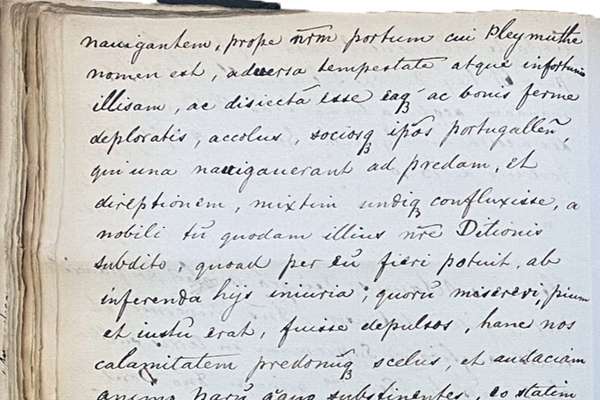
Recently rediscovered, this letter offers new archival evidence into Britain and Portugal's shared history.
Fonds
Catalogue reference: TCB
This record is about the Records created or inherited by the Post Office Telegraph and Telephone Service dating from 1854-1969.
Maybe, but not on The National Archives website. This record is held at BT Archives. How to view it.
Not at The National Archives, but you may be able to view it in person at BT Archives. How to view it.
Records of the telegraph and telephone services of the Post Office held by BT, which also hold some more general records where they are relevant to telecommunications such as Post Office annual reports. Consequently some records in the series date back to before 1870, the year the Post Office took over the telegraph service from private telegraph companies. As well as covering telegraph and telephone services, the records shed light on the early history of wireless, and the beginning of broadcasting in the UK.
Some files of the Post Office External Telecommunications Executive, inherited by the Ministry of Posts and Telecommunications, are in FV 4
Files relating to postal and telegraphic matters passed to the Ministry of Posts and Telecommunications following the Post Office Act 1969 are in BT 229
There are also records relating to telecommunications held either by the Post Office Archives or by BT Archives in POST TCC TCK
Further telecommunications records are in:
The Telegraph Act of 1868 gave Her Majesty's Postmaster General the right to acquire and operate the inland telegraph systems in the UK, which had been installed and operated by independent telegraph and railway companies. The Telegraph Act of 1869 further conferred on the Postmaster-General a monopoly in telegraphic communication in the UK and, on 28 January 1870, the previously privately owned telegraph system was transferred to the State.
In 1878, the Post Office provided its first telephones, on rental terms to a firm in Manchester and, on 20 December 1880, a court judgement was issued in favour of the Post Office in a landmark legal action which laid down that a telephone was a telegraph, and a telephone conversation a telegram, within the meaning of the 1869 Telegraph Act. Independent telephone companies were thereupon obliged to obtain 31-year licences to operate from the Postmaster-General. As a result of this court judgment, the Postmaster-General was to continue providing the telephone service under the provisions of the various telegraph acts until 1951, when the first telephone act was passed.
On 4 April 1896, the Post Office took over the trunk network of the National Telephone Company (the largest of the private telephone service providers) and, in 1905, the Post Office agreed with the National Telephone Company that the company's undertakings would be transferred to the State in 1912. Consequently, on 1 January 1912, the Postmaster General took over the system of the National Telephone Company and soon became the monopoly supplier of telephone services in the UK, with the exception of the municipal service in Kingston-upon-Hull.
The Post Office also became involved in wireless and early broadcasting services: in 1904 the Wireless Telegraphy Act was passed, which conferred licensing powers on the Postmaster General. The 1949 Wireless Telegraphy Act vested responsibility and the necessary statutory powers with respect to regulating the use of radio frequencies in the Postmaster General. In 1969, this responsibility was transferred to the new Ministry of Posts and Telecommunications.
The General Post Office ceased to be a government department in 1969 and, under the provisions of the Post Office Act 1969, the Corporation was split into two divisions - Posts and Telecommunications - which thus became distinct businesses for the first time.
Records created or inherited by the Post Office Telegraph and Telephone Service
Read stories that share a catalogue subject with this record.
Record revealed
Record revealed
Record revealed