Record revealed
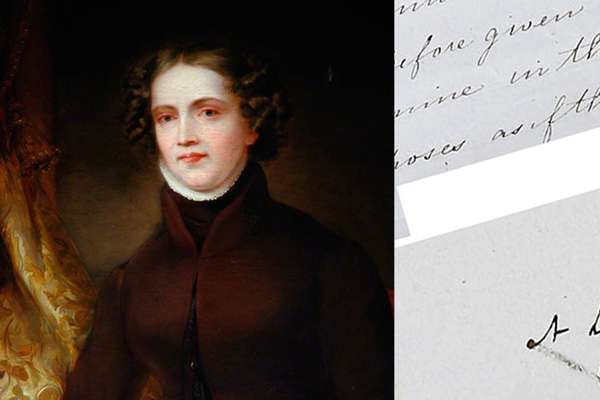
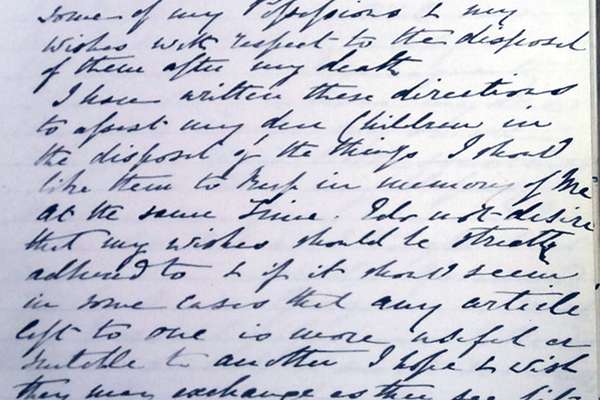
Jane Austen’s will

Explore Jane Austen's will, in her own handwriting, which shows how the novelist planned to share her belongings with family and friends after her death.
Piece
Catalogue reference: E 23/1/1
This record is about the Richard II dating from 1399 Apr 16 in the series Exchequer: Treasury of the Receipt: Royal Wills. It is held at The National Archives, Kew.
No, this record is not available online. However, you can order a copy. Other ways to view it.
Yes, this record is held at The National Archives and is available to see in person. How to view it.
Richard II
Richard II's will, signed and sealed on 16 April 1399, was deposited for safe keeping in the Exchequer during the lifetime of the King. It was placed initially in a locked chest in the Receipt of the Exchequer, recognisable from its description as one in which many documents of primary importance were placed.
Shortly afterwards, but possibly after the King's death, it was removed to the most secure of all the Exchequer's repositories, the chapel of the Pyx, off the cloisters in Westminster Abbey, and placed in a chest bound with bands of iron - probably, that is, in the strengthened chest used to store the Crown jewels and other objects and documents of great value.
Although both the handwriting of the document, and the diplomatic of the dating clause, which cites both anno domini and year of indiction as well as regnal year, suggest clerical authorship of the actual written text of the will, there can be no doubt that the powerful sentiments conveyed are a direct expression of the King's own wishes, the essence of which were probably spoken by him in the French language.
Drawn up shortly before Richard was about to depart for Ireland, and made at a time of political crisis, the will is an extreme statement of personal and political belief. It is an extraordinary document, part statement of religious beliefs and private emotions, part confirmation of political creed and political loyalties; and is obsessively concerned with the regal forms of his obsequies and with the welfare of his soul.
Richard's will affirms the King's deep religious sentiment; his profound sense of the meaning of kingship and personalised regalian creed; and is a testimony also to his continuing love for his dead wife, Anne, (d 1394), with whom he wished to be buried in the Abbey of St Peter, Westminster. The opening phrases of the will are an expression of faith, and of dedication to Richard's particular saints, John the Baptist, Edward the Confessor, and the Virgin Mary. (cf the Wilton Diptych).
The first part of the will proper is concerned with the forms of his obsequies, for which detailed directions are given. Only belatedly, and in the form of a marginal note, does the will consider the possibility that the King might be drowned at sea, or that the obstacles to repatriation of his body might prove insuperable.
Most plate, jewels, and chapel furnishings were left to his (un-named) successor as King of England, provided that such a successor upheld and fulfilled the terms of the will; certain jewels were reserved to fund the works on the nave of Westminster Abbey, with remainder to the executors. A further 6,000 marks were reserved to defray the expenses of the translation of the King's body to Westminster, and for his burial.
By way of spiritual memorial, a chantry of fifteen lepers and a chaplain was to be established; a marginal afterthought endowed his executors with funds for the maintenance of the chantry at both Westminster and Bermondsey. Richard's household and servants were provided for, and legacies left to Thomas, duke of Surrey, and to Edward, duke of Albemarle, John, duke of Exeter and William Scrope, earl of Wiltshire.
The remainder of his treasure, after the payment of debts and legacies, was to go to his successor as King of England, provided that such a successor upheld the ordinances and judgements passed and to be passed in the parliaments of Westminster, Shrewsbury and Coventry and Westminster of the twenty-first and twenty-second years of the reign: that is, the proceedings dating from the period which has been called Richard's 'Second Tyranny'. As such, it is an extraordinary attempt to bind his successor to an extreme view of kingship, and a vindication of his acts of revenge. In default of such a commitment Surrey, Albemarle, Exeter and Wiltshire were to take charge of the treasure, and to maintain those judgements and ordinances to the best of their power.
The remaining clauses of the will secured to his present queen, Isabella, the dowry brought by her; charged the executors with the distribution of his robes to his immediate chaplains and attendants; and appointed executors to have oversight and performance of the will.
The will, which is in Latin, was signed by Richard, in French and apparently holograph, with the words 'Le Roy'; the signature appears to the right of a mark which may be a prior indication by the scribe of the point at which the signature was to be entered, or which may be the mark of the King himself.
The will, witnessed by Robert Braybrook, bishop of London, John Beaufort, marquis of Dorset, Thomas Percy, earl of Worcester and others, unnamed, is sealed with the privy, signet and great seals, the latter on cords of purple and red. The seals are now protected by bags of white leather and green silk lined with leather. The use of green silk suggests that the bags are most probably an example of sixteenth or seventeenth century pre-emptive conservation on the part of the deputy chamberlains of the Exchequer. Despite such protection the signet seal alone remains undamaged.
The circumstances of Richard's deposition and death meant that little of his will was ever put into effect. His wish to be buried at Westminster was, however, honoured nearly a decade and a half later by Henry V, who in 1413 translated the body from King's Langley, reinterring Richard to lie besides his first wife, Anne, in the magnificent tomb prepared at Westminster by Richard in his lifetime and which had cost, between 1395 and 1399, a sum total estimated at £933 6s 8d.( H M Colvin, History of the King's Works, i (London,1963), 225, 487-488; Issues of the Exchequer, ed F Devon (London, 1837), p 332; petition for payment 2 Henry IV, E 28/9).
E 23
See the series level description for more information about this record.
Records of the Exchequer, and its related bodies, with those of the Office of First...
Exchequer: Treasury of the Receipt: Royal Wills
Richard II
Record revealed
The story of
Record revealed
Records that share similar topics with this record.