The story of
Britain’s youngest prisoner of war: John Giles Hipkin
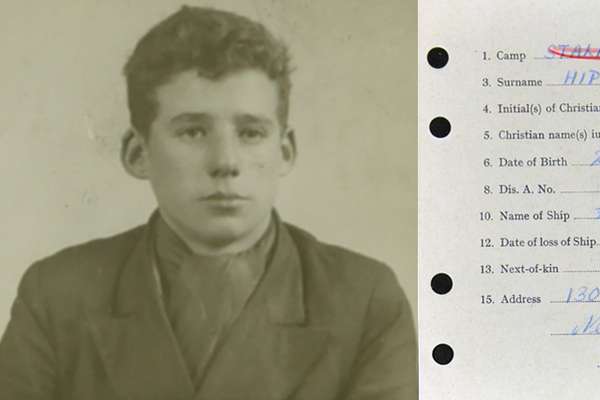
14-year-old cabin boy John Giles Hipkin became Britain's youngest Second World War prisoner of war in 1941 after he was captured at sea.
Sub-sub-fonds
Catalogue reference: DF 5006
This record is about the British Museum (Natural History): Unofficial Archives: Papers of Jacqueline Palmer... dating from 1948-1960.
Maybe, but not on The National Archives website. This record is held at The Natural History Museum Archives, London. How to view it.
Not at The National Archives, but you may be able to view it in person at The Natural History Museum Archives, London. How to view it.
This series consists of the papers (including correspondence and photographs) of Jacqueline Grizel Georgiana Palmer (1918-1961) and relates to her work in the Children's Centre of the Natural History Museum.
Series held at The Natural History Museum are catalogued more fully in its online catalogue (reference DF EXH/706). Online descriptions of some individual records can also be viewed on Discovery, see DF 5006.
The collection has been left, in the main, in the order in which it was received.
Miss Palmer was born in London in 1918. Having trained at the Froebel Educational Institute, Roehampton, she gained her diploma in 1939 and taught throughout the war. Later she went up to Cambridge University to read geography at Newnham College, graduating with honours in 1948.
Having joined the Museum on a part-time basis in the Autumn of 1948, Miss Palmer proposed the development of a Children's Centre as an attempt to encourage and direct the interest of children in the natural world and the Museum. Inaugurated on an experimental basis during the school holidays, the Centre was located on the west side of Central Hall, near to the main entrance. It was an area where children could draw, make models and receive instruction. Miss Palmer was seconded to the Museum by the London County Council who paid her salary.
In 1948 she inaugurated the Junior Naturalists' Club for children aged 10 to 15 who were regular visitors to the Centre and who proved their commitment by producing a piece of fieldwork. The Club had its own committee and met once a week with occasional extra activities. The Club had a small library and programmes of activities were devised by the Committee, under Miss Palmer's guidance. In 1950 a Country Club was started at the suggestion of Sir Norman Kinnear for children aged 13 to 16 living outside London who wanted help with their studies of the natural world. This generated considerable correspondence and subsequently the work of the Country Club was incorporated within that of the Field Observer's Club. This was formed in 1953 as a senior group for young people over the age of 15 so that more appropriate work could be provided for older Centre members. It too had its own committee, programme and selection procedure. An Argus Club for scientific illustration, intended for children aged between 13 and 17, was also formed but was later incorporated into the Field Observer's Club. Close ties were always maintained between these two clubs and both continued their work after Miss Palmer left the Museum in 1956. The Junior Naturalists' Club was linked to the Chelsea Physic Garden while the Field Observer's Club became independent of any other organization. The latter was affiliated to the International Youth Federation for the Study and Protection of Nature and the former to the Council for Nature, an alliance resulting in productive exchanges. Miss Palmer left the Museum in 1956 and died from cancer on 3 January 1961.
British Museum (Natural History): Unofficial Archives: Papers of Jacqueline Palmer (1918-1961)
Read stories that share a catalogue subject with this record.
The story of