Record revealed
Japanese Instrument of Surrender, 1945
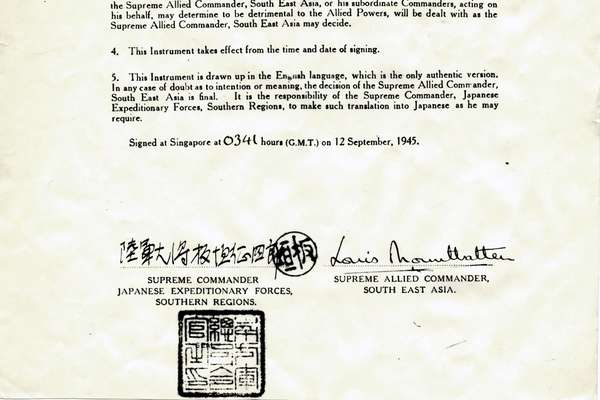
After six years of brutal global conflict, this document marked the end of the Second World War.
Series
Catalogue reference: WO 400
WO 400
This series contains surviving records of service for non-commissioned officers and other ranks who served in the Life Guards, the Royal Horse Guards and the Household Battalion, and whose Army service concluded in these regiments. In accordance...
This series contains surviving records of service for non-commissioned officers and other ranks who served in the Life Guards, the Royal Horse Guards and the Household Battalion, and whose Army service concluded in these regiments. In accordance with normal Army administrative practice of the time, the transfer of a man to another regiment meant the transfer also of his Army service record. Therefore this series does not generally contain records of service for men who served in the above regiments but who subsequently served in other regiments of the British Army.
The records are arranged in eight sub-series, as follows:
In each sub-series, the records have now been arranged alphabetically by name, each piece being one box of records and being described by the first and last names within that box. The dates given above for each sub-series are dates of enlistment.
[A microfiche copy (but not including the Household Battalion) was created, probably in the 1980s, and has been retained by the Household Cavalry Museum. In the course of that microfilming project, Box No. 1 in the Royal Horse Guards Series 1, containing records numbered between 1 and 250, was lost. Fortunately, the loss occurred after microfilming and the missing originals have therefore been replaced with hard copies taken from the microfilm.]
The item references equate to the regimental numbers of the individual soldiers on the original documents. Where this number is not extant and hence unknown, the item reference concludes with a 'U'.
Records of Chelsea Pensioners discharged pre-1914 WO 131
For officers who served in the Household Cavalry up to and including the First World War see: WO 374
Records of World War 1 soldiers, other regiments WO 364
The Household Cavalry Museum, at Combermere Barracks in Windsor, holds an extensive range of related material, including regimental order books, rolls, returns etc
from 2003 Ministry of Defence
The Household Cavalry: The Life Guards and The Blues and Royals.
The Life Guards were formed at the restoration in 1660 from a group of eighty Royalists who had gone into exile with King Charles II after his defeat at the Battle of Worcester (1652). They first saw action at the Battle of Sedgemoor in 1665 (the Monmouth Rebellion) and subsequently in both the Jacobite Wars and during the war of Austrian Succession (1742-46). They were redesignated the 1st and 2nd Life Guards in 1788, a period from which the majority of today's state dress originates, and formed the front charging line of the Household Cavalry Brigade at the Battle of Waterloo (1815), staging the famous charge against the French Cuirassiers that saved the British centre from being overrun.
The Blues and Royals were formed in 1969 from an amalgamation of The Royal Horse Guards (The Blues) and The Royal Dragoons (The Royals). The Royal Horse Guards trace their origins to a force raised by Oliver Cromwell prior to the second invasion of Scotland, but the parliamentary officers were replaced by royalists in 1660. The origins of the Royal Dragoons are a troop of horse raised by King Charles II in 1661 to form part of the garrison at Tangier. On their return to England in 1683, they were regimented as Dragoons, the term being derived from the 'dragon', a musket suitable for mounted infantry.
Soldiers' Documents: The Household Cavalry
Read stories that share a catalogue subject with this record.
Record revealed
The story of
Focus on
Records that share similar topics with this record.