Record revealed
Japanese Instrument of Surrender, 1945
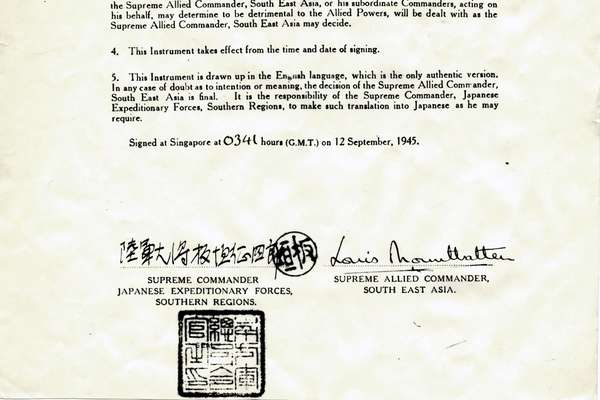
After six years of brutal global conflict, this document marked the end of the Second World War.
Series
Catalogue reference: WO 215
WO 215
This collection of war diaries and papers was created specially by the General Headquarters Liaison Regiment, and gives a compact and almost complete history of the unit.
This collection of war diaries and papers was created specially by the General Headquarters Liaison Regiment, and gives a compact and almost complete history of the unit.
This unit originated in 1939 as No 3 British Air Mission (an RAF unit). Its task was to liaise with the Belgian General Staff, to pin-point British and Belgian forward positions so that allied aircraft would not attack them in error. The unit was commanded by an RAF officer, with an army officer joining in November 1939 as military observer. Following the attachment of an army contingent, the unit was re-designated No 3 Military and Air Mission. (The unit was initially code-named 'Phantom', but this later became part of the official designation.)
After the evacuation from Dunkirk (Operation Dynamo) the unit was re-established in England as No 1 GHQ Reconnaissance Unit. However, following the creation of the Reconnaissance Corps in January 1941 it was decided that the title GHQ Liaison Regiment should be adopted to avoid any confusion.
For the remainder of the war the regiment operated in most theatres, including north-west and south-east Europe, north Africa and the Mediterranean. Their chief task was by this time the transmission of immediate battle information back to allied commanders.
Among the regiment's personnel were the actor David Niven and Robert Mark, later to become commissioner of the Metropolitan Police.
War Office: General Headquarters Liaison Regiment: War Diaries and Papers, Second World War
Read stories that share a catalogue subject with this record.
Record revealed
Record revealed
The story of
Records that share similar topics with this record.