Record revealed
Copy of Henry VIII's diplomatic assurances to João III of Portugal
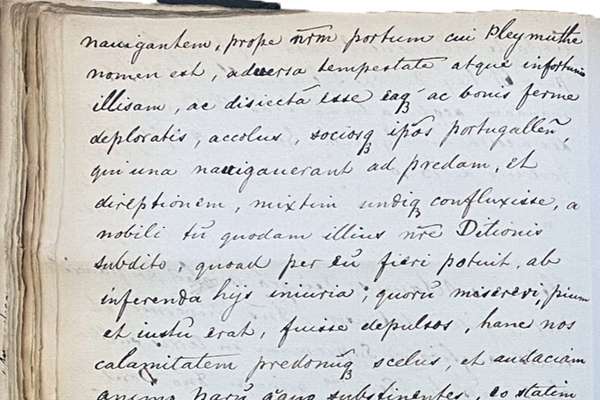
Recently rediscovered, this letter offers new archival evidence into Britain and Portugal's shared history.
Sub-fonds
Catalogue reference: Division within DF
This record is about the Records of the Department of Mineralogy dating from 1796-1993.
Maybe, but not on The National Archives website. This record is held at The Natural History Museum Archives, London. How to view it.
Not at The National Archives, but you may be able to view it in person at The Natural History Museum Archives, London. How to view it.
Records of the Department of Mineralogy of the Natural History Museum.
The Department of Mineralogy has its origins in the Department of Natural and Artificial Productions which was set up at the foundation of the British Museum in 1756. In 1806 it was renamed the Department of Natural History and Modern Curiousities and was under the keepership of George Shaw (1751-1813) and later Charles Dietrich Eberhard Konig (1774-1851).
In 1837 the Department was divided into three branches, of which Mineralogy and Geology was one, and in 1856 the branch became a department in its own right, almost immediately being divided into the two departments of geology and Mineralogy. The first keeper of Mineralogy was M H N Story-Maskelyne (1823-1911), a lecturer and later Professor at Oxford, a Member of Parliament, and an agriculaturallist and country gentlemen.
Thomas Davies (1837-1932) joined the Department as an attendant in 1858 and took charge of the rock collection. A chemical laboratory was provided in Great Russell Street in 1867, and Walter Flight (1841-1885) was appointed analyst. By the time the Department moved to South Kensington in 1881, it had a staff of ten, and was responsible for a huge collection of rocks, minerals and meteroites.
In South Kensington the Department initially developed around the collections of minerals, meteorites and rocks.
Cataloguing and curation of the mineral collection, with the development of crystallographic and chemical techniques involved a number of staff, including Lazarus Fletcher (1854-1921), Leonard J Spencer (1870-1959) and Jessie M Sweet (1901-1979). The meteorite collection was looked after by successive keepers, including Fletcher, George T Prior (1862-1936) and W Campbell Smith (1887-1988), while the rocks were worked on by Prior, Campbell Smith and Stanley E Ellis (1904-1986). The chemical laboratory, staffed by Prior, Max H Hey (1904-) and Alan A Moss (1912-1990), was involved in work on all these three collections. Many staff worked in more than one of these ares, and the Department was not formally divided into sections until the 1950s.
Two important developments came with the appointment of Frederick A Bannister (1901-1970) in 1927 to develop X-ray crystallography, and the formation of an Oceanography Section under John D Wiseman in 1935, following the transfer of the John Murray collection from the Department of Zoology. New methods of rapid mineral analysis were developed in the 1950s, and the department's first electron microprobe was delivered in 1964.
By 1975 the department had a staff of 37 and was divided into nine sections, including General Mineralogy, Petrology, Meteorites, Oceongraphy, Chemistry and the Departmental Library .
Records of the Department of Mineralogy
Read stories that share a catalogue subject with this record.
Record revealed
Record revealed
Record revealed