Record revealed
Report on the British Indian Army, 1943
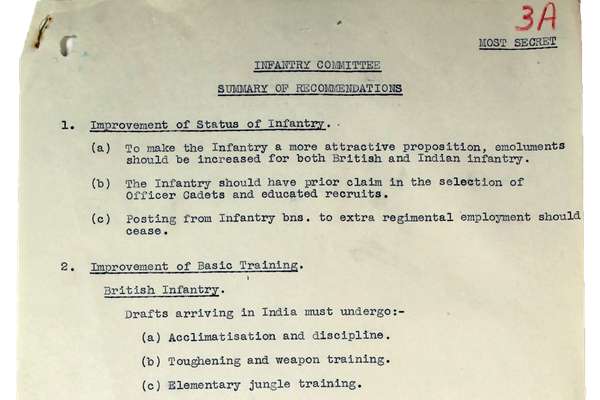
This Second World War War Office document assessed the British Indian Army's battle readiness and made recommendations for its development.
Series
Catalogue reference: WORK 100
WORK 100
The records in this series relate to the maintenance of the landscape of Brompton Cemetery; to the history of its buildings, the care of its historic memorials and the variety of people who are laid to rest in this conservation area. There are...
The records in this series relate to the maintenance of the landscape of Brompton Cemetery; to the history of its buildings, the care of its historic memorials and the variety of people who are laid to rest in this conservation area. There are also some papers relating o the administration of the cemetery.
There are several sets of records:
Minute books of the Cemetery Company are in WORK 6
Working plans relating to the layout and use of the cemetery are in WORK 98
Files relating to the Chelsea memorial at Brompton are in WORK 20
Registered files relating to maintenance are in WORK 19
Registered files relating to administration of the Cemetery are in WORK 16
Maps and plans are in WORK 38
Burial registers, common graves books, stone ledgers and burial books are in WORK 97
from 2012 Royal Parks Agency
The 1832 cholera epidemic in London, highlighted the consequences of inadequate burial ground provision for such a large population concentration. The response from parliament was to support the creation of the first commercial cemetery in 1832 at Kensal Green. Subsequent legislation authorised the establishment of a total of seven large commercial cemeteries (from 1832 to 1841) forming a ring around London.
Brompton Cemetery:
In 1837, The West of London and Westminster Cemetery Company bought 40 acres of land from the estate of William Edwardes, 2nd Baron Kensington (1777-1852) in West Brompton. A design competition was held for the proposed cemetery. Benjamin Baud (assistant to the architect Sir Jeffry Wyatville) submitted the best designs for the buildings and walls; Stephen Geary was appointed architect; Isaac Finnemore and John Claudius Loudon (a garden designer and eminent horticultural writer) were the landscaping consultants.
Brompton Cemetery was consecrated in 1840, but not all of the original 'garden-cemetery' design was realised, as The West of London and Westminster Cemetery Company ran into financial trouble. The general Board of Health bought Brompton Cemetery in 1852 from its financially stretched Cemetery Company, so making it the first (and only) London cemetery to become Crown property.
From 1854 to 1939 Brompton was popular as a military cemetery. Since its formation in 1916, The War Graves Commission has looked after those graves at Brompton that fall within its remit.
As Crown property, all works relating to the buildings were the responsibility of the Office of Works, Royal Parks Division from 1852. The responsibility was passed to successor bodies, including the Department of the Environment in 1970. The Department of National Heritage took over this responsibility from May 1992. Management of Brompton Cemetery passed to The Royal Parks, an executive agency of the Department for Culture media and Sport (DCMS). The agency was established on 1 April 1993 by the Department of National Heritage, which became the DCMS in 1997.
In 1997 the Royal Parks and Open Spaces Regulations were amended, and for the first time were applied to Brompton Cemetery. The architecture of the memorials reflects the diversity of the cultural background of the people buried there, and includes some listed architectural treasures. The Cemetery was designated a conservation area in 1985 and, reflecting its status as one of the finest Victorian Metropolitan cemeteries in the country, is grade II* listed in the national Register of Parks and Gardens of special historic interest in England, compiled and maintained by English Heritage under the National Heritage Act of 1983.
Office of Works and successors: Royal Parks and Pleasure Gardens: Brompton Cemetery: Unregistered Files, Papers, Drawings and Photographs
Read stories that share a catalogue subject with this record.
Record revealed
Record revealed
Records that share similar topics with this record.