Record revealed
Copy of Henry VIII's diplomatic assurances to João III of Portugal
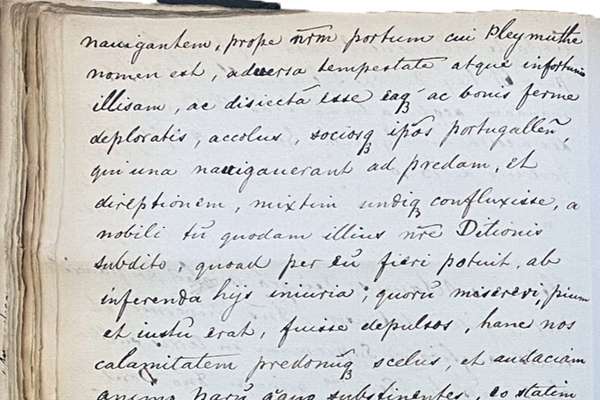
Recently rediscovered, this letter offers new archival evidence into Britain and Portugal's shared history.
Series
Catalogue reference: PRO 30/49
PRO 30/49
One of the three copies of the abortive Treaty of Union with Scotland with 63 pendant seals.
One of the three copies of the abortive Treaty of Union with Scotland with 63 pendant seals.
Until 1949, only one of the three sealed counterparts of the abortive treaty was thought to exist: that sent to the Scottish parliament survived in a decayed state, with all its seals cut off, in the General Register House in Edinburgh. However, in 1949 a second counterpart came to light in private custody, in the Ham House collection. This was in almost perfect condition, lacking only four of the seals.
Ham House , in August 1949
A century before the successful Act of Union of 1707, James I of England and VI of Scotland had made considerable efforts to legally unite his two kingdoms. In May 1604, the English parliament met, and was persuaded to appoint commissioners to discuss terms for a treaty of union with commissioners appointed by the Scottish parliament in July 1604. In October 1604 the commissioners (forty English and twenty eight Scots) met at Westminster, and were able to reach a sufficient agreement for their conclusions to be drawn up in the form of a treaty between the two parliaments by Sir Francis Bacon and Sir Thomas Hamilton, Lord Advocate of Scotland.
Three counterparts of the treaty were made, one for each parliament, and one for the king. On 6 December 1604, all the commissioners present (save one) signed and sealed the three documents. Before the treaty could actually take effect, it had to be passed by both the English and the Scottish parliaments. In August 1607, the Scots passed the 'act anenst the unioun of Scotland and England'. However, this was conditional upon the English parliament passing a like act, which it never did.
Anglo-Scottish Treaty
Read stories that share a catalogue subject with this record.
Record revealed
Record revealed
Record revealed

Records that share similar topics with this record.