Focus on
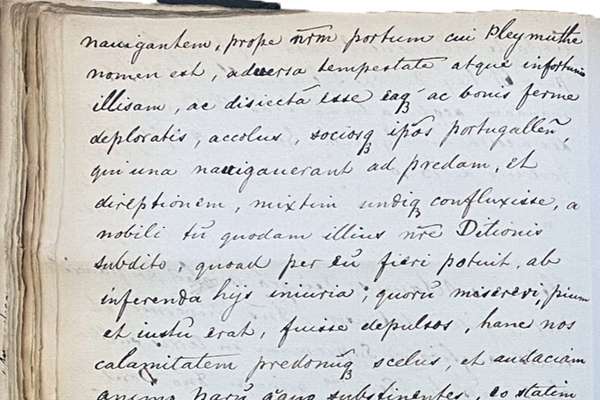
The corsair state of Rabat-Salé

On the Atlantic coast of Morocco are two cities that became one of the most substantial Islamic ports of the 17th Century.
Series
Catalogue reference: PRO 23
PRO 23
This series is made up of digital images in greyscale of 6500+ plaster and rubber moulds and impressions of seals relating to a wide variety of documents held across The National Archives collections and across all chronological periods. The...
This series is made up of digital images in greyscale of 6500+ plaster and rubber moulds and impressions of seals relating to a wide variety of documents held across The National Archives collections and across all chronological periods.
The oldest moulds date from the late nineteenth century. From then until around the mid-1960s the moulds were made from Plaster of Paris sifted through fine gauze. This material was then superseded by silicone rubber, which continued to be used until the late 1990s, when the practices of moulding and casting ceased.
Seal moulds can be extremely valuable, particularly in cases where surviving seals have suffered damage since moulding or where the original seal has now been lost (in some cases the mould might be the only surviving evidence of an impression or of a legend in full), although in a number of examples the separation of seal, and therefore mould, from parent document means little can be deduced of ownership or date.
The digital images have been scanned at 800dpi (although presented as compressed JPEGs), to provide high resolution, research-quality surrogates. Care has been taken when cataloguing the digital images to examine the original seals in cases where identification is not obvious from the mould and its associated documentation.
In terms of access, catalogue descriptions of the digital images include the following content:
Each image has also been assigned a broad category relating to the type of seal and / or sigillant, and the images can be searched by name and category; for example:
The overall date range of the seal moulds and original seals are: Moulds, 1880-1995; Seals, 1136-1953.
Each mould was assigned a number as it was created and the digital images correspond to this numeric arrangement.
Please Note that these digitised seal moulds are being released (from March 2018) on a rolling basis and hence there are gaps in the numerical piece sequence.
There is a card index to seals held at The National Archives: for further information please see section in the Administrative background.
The practice of moulding and casting seals had its heyday in the 1920s under Hilary Jenkinson, then in charge of the Repairing Department, who took a strong personal interest in seals and attempted to demystify the 'trade secrets' of the process while trialling new techniques. He described the process of making a permanent mould 'as perhaps the most important of all the processes connected with seals' (Jenkinson, 'Some Notes', p396). Under his direction a procedure was established that meant any seal which passed through the Repairing Department would have a mould taken. Consulting widely among the European archive community, The Public Record Office pioneered techniques of moulding and casting and regularly received requests for the production of seals held by other institutions and individuals.
Card index to seals held at The National Archives:
The index was compiled from 1913 and many of the cards are marked 'M' to indicate that a mould had been taken of a particular seal. It is clear from Sir Hilary Jenkinson's writings that the process of better recording and cataloguing the seals collections at the Public Record Office preceded directly the systematic improvements to packing, repairing, moulding and casting processes in the Repairing Department (Jenkinson, 'Some Notes', p388). The card index is arranged by category of seal and/or sigillant, for example, Royal, Monastic, Armorial. The physical cards are arranged in individual drawers corresponding to these broad categories and can only be accessed in the Map and Large Document Reading Room. Digital images of the cards can be browsed by drawer in series QFA 1, the Digitised Seals Register.
Domestic Records of the Public Record Office, Gifts, Deposits, Notes and Transcripts
Public Record Office: Surrogate Copies of Records: Moulds or Impressions of Seals deposited for examination
Focus on
Focus on

Record revealed
Records that share similar topics with this record.