Record revealed
Copy of Henry VIII's diplomatic assurances to João III of Portugal
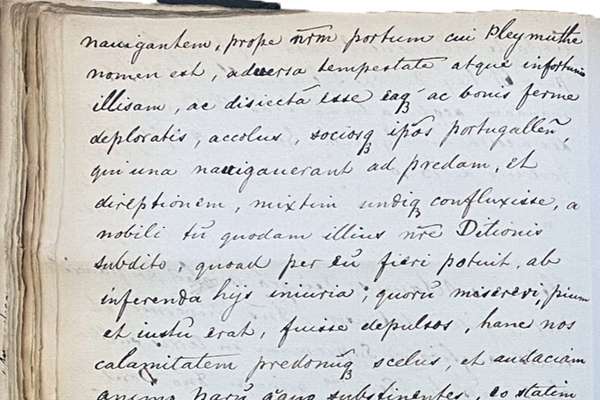
Recently rediscovered, this letter offers new archival evidence into Britain and Portugal's shared history.
Sub-sub-fonds
Catalogue reference: POST 85
This record is about the Post Office: Telephones, Municipal dating from 1894-1938.
Maybe, but not on The National Archives website. This record is held at BT Archives. How to view it.
Not at The National Archives, but you may be able to view it in person at BT Archives. How to view it.
This series comprises a collection of reports on municipal telephone systems, public enquiries into applications by local authorities to borrow money for establishing services, and copies of the Postmaster General's licences and agreements.
Please see BT Archives online catalogue and The Postal Museum's online catalogue for descriptions of individual records within this series.
Note that these records have been rearranged to fit the scheme of arrangement used at BT Archives. The majority of them now make up TCB 279; the POST 85 reference numbers are now obsolete. Please contact BT Archives for more information.
From 1880, the Post Office enjoyed a monopoly in respect of the provision of telegraph and telephone services, following a legal ruling on the powers conferred on the Postmaster General by the Telegraph Act 1869. Private telephone companies in competition with the Post Office, principally the National Telephone Company, thereafter operated under licence from the Post Office. This remained the situation until 1912, whenthe Post Office took over the National Telephone Company which, by that time, was the last remaining telephone concern outside public control.
Prior to 1912 there had been increasing public concern about the perceived ineffieciency and excessive cost of the National Telephone Company's services. This concern was given voice in part by certain local authorities.
The Municipal Corporations Association, representing most of the English Boroughs, was in favour of state control of the company's system. On the other hand, Scottish municipalities, led by the Glasgow Corporation (who had unsuccessfully applied for a telephone licence as early as 1893), supported local authority controlled services.
Following the investigations of a House of Commons Select Committee and other official enquiries, the Government in 1899 decided to operate a large Post Office run telephone system in London, and to leave competition with the National Telephone Company in provincial towns to local authorities to whom licences would be issued.
This policy was embodied in the Telegraph Act of that year. Later in the year, the Post Office began laying an extensive system of telephone lines in London, and a network of small exchanges in rural areas not previously served by the National Telephone Company.
The policy of municipal telephony in provincial towns would have seemed a natural development in adding to the already wide powers of local authorities in providing gas, water, electricity, transport and other public amenities.
In the event, it was to prove a failure: of 1,334 urban local authorities that might have sort licences under the Telegraph Act, 1899, only 55 applied for information. Of these, only 13 asked for licences, all of which were granted: Glasgow, Belfast, Grantham, Huddersfield, Tunbridge Wells, Brighton, Chard, Portsmouth, Hull, Oldham, Swansea, Scarborough and West Hartlepool.
Only six actually opened telephone system: Glasgow (1901), Tunbridge Wells (1901), Swansea (1902), Portsmouth (1902), Brighton (1903) and Hull (1904). Only the service provided by Hull continues to the present day. The remaining five services were all sold to the National Telephone Company or to the Post Office by the end of 1913.
Post Office: Telephones, Municipal
Read stories that share a catalogue subject with this record.
Record revealed
Record revealed
Record revealed