Record revealed
Copy of Henry VIII's diplomatic assurances to João III of Portugal
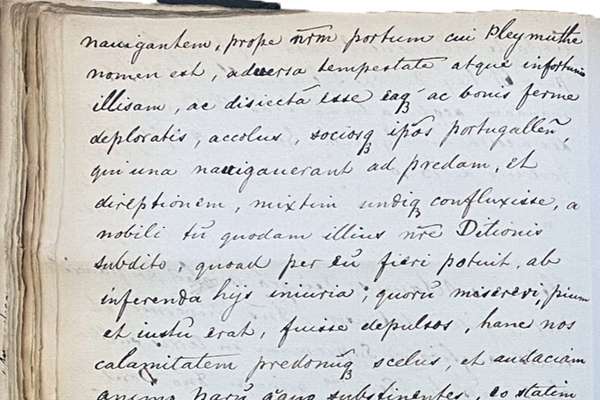
Recently rediscovered, this letter offers new archival evidence into Britain and Portugal's shared history.
Sub-sub-fonds
Catalogue reference: POST 55
This record is about the Post Office: handstruck date stamps: proof books dating from 1823-1995.
Maybe, but not on The National Archives website. This record is held at The Postal Museum. How to view it.
Not at The National Archives, but you may be able to view it in person at The Postal Museum. How to view it.
This series consists primarily of 'proof books', that is, bound volumes and files containing specimen impressions of new date, machine cancellation or other handstruck stamps (both steel and rubber) for postal use, authorisations and instructions for use, hand stamp destruction records and historical summaries on machine cancellations.
These two main collections of proof books have serious gaps, notably, for steel stamps, for the period after 1821, and, for rubber stamps, after 1831. It is believed that the proof books for these periods were lost in the major fire which occurred in 1957 at the Supplies Department, Mount Pleasant, where these records were once housed. Regrettably, when the surviving volumes in these two collections were rebound in [c1960], the original volume numbers were lost, and new artificial numbering sequences were given to the newly bound volumes. This destroyed the evidence once offered by the original bindings, making it impossible now to determine exactly what has been lost from the original series.
Please see The Postal Museum's online catalogue for descriptions of individual records within this series.
The material is arranged in date order within series
The first stamp to be introduced for postmarking purposes was the hand-struck stamp introduced in 1660 by Colonel Henry Bishop, Postmaster General, to"put upon every letter showing the day of the month that every letter comes to the office, so that no Letter Carrier may dare to detain a letter from post to post, which before was usual". These so-called Bishop marks were the first British postmarks and consisted of a simple circle divided horizontally with the indication of the month in one half and the day of the month in the other.
In 1840 hand-struck cancellation stamps were introduced, to deface the newly introduced adhesive postage labels (stamps) and prevent their fraudulent re-use.
The earliest stamps were made of wood, and later brass: and were probably manufactured locally. By 1825, however, they were being made of steel, and issued centrally. This change is reflected in the fact that the earliest proof book in the collection commences in 1825. With the introduction of the Parcels Post in 1883, where steel stamps would not have been effective, pliable stamps made of cork were introduced. By 1885, however, stamps made of rubber had come into use for the Parcel Post and other uses.
Post Office: handstruck date stamps: proof books
Read stories that share a catalogue subject with this record.
Record revealed
Record revealed
Record revealed