The story of
Ravenser Odd
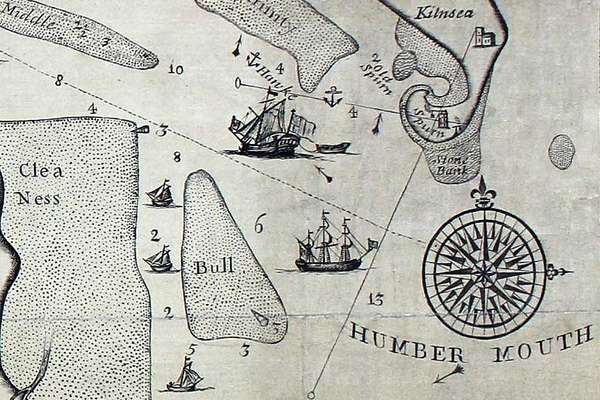
Ravenser Odd was a short-lived island in the mouth of the River Humber. It rose from the sea in the early 13th century and had sunk beneath the waves by 1360.
Division
Catalogue reference: Division within OS
Division within OS
Records of the Field Directorate (formerly the Trigonometrical and Levelling divisions) relating to triangulation and survey work. Old Triangulation records are in OS 2 and OS 17, County Series parish acreage lists in OS 4, magnetic surveys in...
Records of the Field Directorate (formerly the Trigonometrical and Levelling divisions) relating to triangulation and survey work.
Old Triangulation records are in OS 2 and OS 17, County Series parish acreage lists in OS 4, magnetic surveys in OS 6, branch files in OS 13, papers in OS 15, records of the Second Geodetic Levelling in OS 16, Cambridge Radio Telescope observations in OS 18. Original name books are in OS 34. 25-inch scale object name books are in OS 35 and one-inch scale name books (Seventh Series) are in OS 50. National grid object name books are in OS 67. Triangulation Stations files are in OS 69.
A number of series of technical records are still held by Ordnance Survey: OS 19, OS 20, OS 21, and OS 22.
The Field Directorate (formerly the Trigonometrical and Levelling Divisions) under the control of the Director General is responsible for all survey work.
The framework of control points, both horizontal and vertical, on which the national surveys are founded is provided by triangulation, based on the same principles as the trigonometrical work of the nineteenth century. The original or 'Old' triangulation did not provide satisfactory coverage, even after the figures were re-computed and reorganised as the Principal Triangulation in 1855. The Principal Triangulation (published in 1858) was a selection of data from the mass of observations made earlier in the century.
The information on Ordnance Survey maps relating to altitudes and benchmarks has varied over time in accordance with the provenance and reliability of the data. This reflects, firstly, the use of data from earlier levellings and, secondly, the use of the old Liverpool datum (Liverpool was the first datum used for Ordnance Survey maps). This datum was the mean of the high and low water marks taken over ten days in 1844.
There have been three main levellings (and associated lower order observations) as below:
First primary levelling: 1840-60 (England and Wales)1840-60 (Scotland)
Second geodetic levelling: 1912-21* (England and Wales)1936-52 (Scotland)(* Except parts of East Anglia and Kent, completed 1946-51)
Third geodetic levelling: 1950-68 (England and Wales)1956-68 (Scotland)
Cyclic relevelling: 1956- (England and Wales)1959 (Scotland)
When work began on the second geodetic levelling, the Newlyn datum was established. The Ordnance Datum, on which this levelling is based, is the mean level of the sea at Newlyn, Cornwall, calculated from hourly readings of the sea level recorded on an automatic tide gauge from 1 May 1915 to 30 April 1921. The Tidal Observatory Bench Mark is 4.751 metres above the datum.
In 1922, work began on converting heights published on new editions of Ordnance Survey maps to the Newly datum, but it was many years before the policy could be implemented in relation to the 1:2,500 series. In 1929, a compromise solution was adopted, in which the difference between the levels derived from the Liverpool and the Newlyn data was published in the sheet footnotes; this varied with locality, but was given so as to be accurate to the nearest 0.1 foot over the limited area of any 1:2,500 sheet. Before 1929, bench mark levels were given to one tenth of a foot, but thereafter to two decimals of a foot, for example, BM 574.35; after 1929 surface heights were shown along roads in the manner + 392.
In 1935, the re-triangulation of Great Britain was begun: it was completed in 1962. In this connection, the Second Geodetic Levelling took place between 1937 and 1952. This new primary triangulation, with further secondary and tertiary triangles subdividing it, is the scientific basis of all modern Ordnance Survey maps.
Records of the Directorate of Field Survey and predecessors
Read stories that share a catalogue subject with this record.
The story of
Records that share similar topics with this record.