Record revealed
Request for compensation for the Boston Tea Party
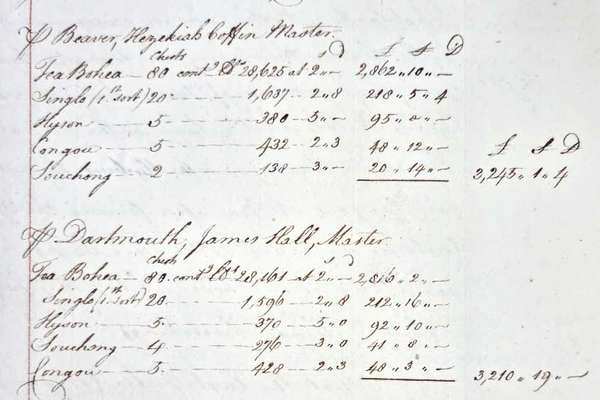
On 16 December 1773, 340 chests of tea were thrown into Boston harbour by protesting colonists. This letter from the East India Company requests reimbursement.
Division
Catalogue reference: Division within IR
Division within IR
Records relating to the collection and accounting of inland revenue. Registered files of the Accountant and Comptroller General's Office are in IR 76, with its parochial and land tax ledgers in IR 2; its records relating to drainage advances in...
Records relating to the collection and accounting of inland revenue.
Registered files of the Accountant and Comptroller General's Office are in IR 76, with its parochial and land tax ledgers in IR 2; its records relating to drainage advances in IR 3; its charge duplicates, balancing statements, and discharge and default schedules in IR 11; and its schedule A comparison lists in IR 14.
The Accountant and Comptroller General's Office originated in the amalgamation of the offices of Accountant General of Excise and Comptroller General of Inland Revenue in 1850 under a single accountant and comptroller general. In 1860, when the Office took over the accounting duties relating to land tax, income tax and assessed taxes from the Inspector General's Department, three chief accountants were appointed for stamps, taxes and excise respectively, each having the duty of examining the accounts relating to every source of their particular branch of revenue.
As a consequence, the office was renamed the Accountant's Department, but reverted to its former title when the Board returned to a single accountant and comptroller general.
In 1877 this department absorbed the separate Office of Registrar of Warrants, and later in 1891 the Receiver General's Office, by which it became responsible for the Board's receipts and disbursements as well as its accounts. Later it also became responsible for collection of the revenue, as since 1931 the collectors, who were formerly appointed by local general commissioners, were appointed and employed by the Board.
Consequently the accountant and comptroller general became the principal finance officer of the Board, and this office handled a number of functions relating to the collection for and accounting of the inland revenue, except for Scotland which had an autonomous organisation under a comptroller of stamps and taxes. Two of the Office's divisions were concerned with collection of taxes:
The Collection Division (AG/C), which was responsible for the collection of income tax, corporation tax and national insurance graduated contributions. This Division was organised largely on a local basis with most of its staff employed in local collection officesThe General Accounting Division (AG), which was the central accounting machine of the Board, generally responsible for receiving, controlling and bringing to account all taxes that were paid centrally, for payment of salaries, and preparation of the annual estimates and the appropriation account.There was also an Audit Division (AG/A), concerned with the audit of employers' records under the Pay As You Earn system, the accounts of local collection offices and repayments of tax authorised by inspectors of taxes. An Assessments Division (though formally a division of the Secretaries Office) was for practical purposes a branch of the Accountant and Comptroller General's Office. Its main responsibility was the collection of taxes which the local collector was unable to recover.
In 1975, following recommendations made by the Management Review Committee, the income tax assessing and recovery work hitherto carried out by the Chief Inspector of Taxes and the Accountant and Comptroller General, was reconstituted in a merged regional structure overseen by management divisions. The Accountant and Comptroller General's Office was abolished and end of year accounting on a national basis became the responsibility of the newly created Finance Division's Central Accounting Office.
Records of the Accountant and Comptroller General's Office
Read stories that share a catalogue subject with this record.
Record revealed
Focus on
Record revealed
Records that share similar topics with this record.