Record revealed
Hoax letter signed by ‘Jack the Ripper’
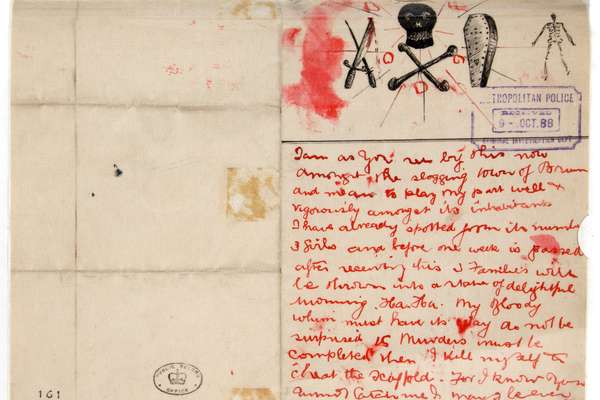
This is one of hundreds of letters in police files claiming to have been written by the infamous Whitechapel Murderer – otherwise known as 'Jack the Ripper'.
Department
Catalogue reference: SFO
SFO
Records created by the Serious Fraud Office (SFO). Comprises: Criminal Case Files: SFO 1 Corporate Files: SFO 2
SFO
1988-
Records created by the Serious Fraud Office (SFO).
Comprises:
Criminal Case Files: SFO 1
Corporate Files: SFO 2
Public Record(s)
English
2 series
Open unless otherwise stated
Serious Fraud Office
The Serious Fraud Office (SFO) is a non-ministerial government department that investigates and prosecutes serious or complex fraud and corruption in England, Wales and Northern Ireland and was established by the Criminal Justice Act 1987. As one of the Law Officers' Departments, the SFO reports to and is accountable to the Attorney General for England and Wales.
During the 1970s and early 1980s there was considerable public dissatisfaction with the UK system for investigating and prosecuting serious or complex fraud and the government established the independent Fraud Trials Committee in 1983. Chaired by Lord Roskill, it considered the introduction of more effective means of fighting fraud through changes to the law and to criminal proceedings. The Roskill Report (Fraud Trials Committee Report) was published in 1986. Its main recommendation was to set up a new organisation responsible for the detection, investigation and prosecution of serious fraud cases. The organisational structure it proposed, in which investigators and prosecutors work together from the start of a case, is called the Roskill model and is the structure adopted for the SFO. As a result, the Serious Fraud Office and its unique powers were created by the Criminal Justice Act 1987 and the SFO established in April 1988.
Section 2 of the Criminal Justice Act 1987 grants the SFO special compulsory powers to require any person (or business/bank) to provide any relevant documents (including confidential ones) and answer any relevant questions including ones about confidential matters. The SFO is unique in that its role is to both investigate and prosecute. Its case teams are therefore made up of investigators, lawyers, law clerks and forensic accountants and over 80% of staff are specialist caseworkers. As a specialist organisation the SFO investigates only the most serious types of economic crime. As a result, a potential case must meet certain criteria before it is taken on. In deciding the Director will take into account all the circumstances of the case and consider: cases which undermine UK commercial/financial PLC in general and the City of London in particular; cases where the actual or potential loss involved are high; cases where actual or potential harm is significant; cases where there is a very significant public interest element; and new species of fraud.
The SFO is the principal enforcer of the Bribery Act 2010, which has been designed to encourage good corporate governance and enhance the reputation of the City of London and the UK as a safe place to do business.
The SFO's jurisdiction does not extend to Scotland where fraud and corruption are investigated by Police Scotland through their Specialist Crime Division and prosecutions are undertaken by the Economic Crime Unit of the Crown Office and Procurator Fiscal Service.
Record revealed
Focus on

The story of
Records that share similar topics with this record.