Record revealed
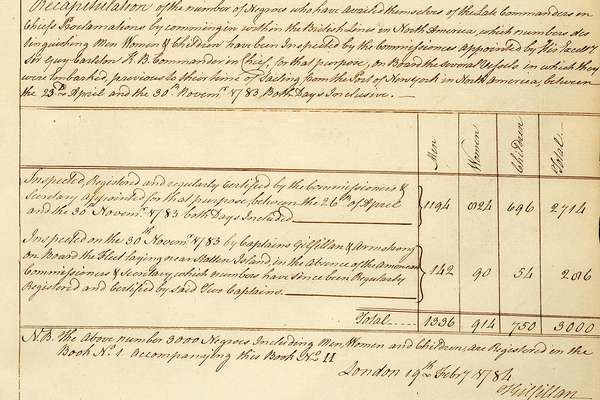
Affidavit describing the uprising of enslaved people onboard the Bedford

This affidavit is testament to the lengths enslaved African people went to in seeking their freedom.
Series
Catalogue reference: T 71
T 71
Registers of the Office for the Registry of Colonial Slaves, 1813 to 1834, most of which are indexed under the names of the owners or plantations; and records of the Slave Compensation Commission, comprising the proceedings of the assistant...
T 71
1812-1851
Registers of the Office for the Registry of Colonial Slaves, 1813 to 1834, most of which are indexed under the names of the owners or plantations; and records of the Slave Compensation Commission, comprising the proceedings of the assistant commissioners who were sent to the several colonies, valuers' returns, registers of claims with indexes, original claims and certificates, counter-claims, adjudications in contested cases, certificates for compensation and lists of awards, commissioners' hearing notes and minutes, accounts, etc.
Selected information about slave owners and the Slave Compensation Commission is searchable through the British slave-ownership database.
Images and indexes to most slave registers are available on Ancestry.
Catalogue entries for slave registers for Trinidad (T 71/501-519) were enhanced in February 2021 using information supplied by Robert M Simon.
For other lists of awards see AO 14
For records relating to payment of claims see NDO 4
Public Record(s)
English
1631 volume(s)
Following the Acts of Parliament of 1807 and 1811 that abolished the slave trade and made it a felony, many British colonies instituted registers of people who were deemed to be lawfully enslaved.
A further Act of 1819 established an Office for the Registry of Colonial Slaves in London, and ordered that it should receive copies of the pre-existing colonial registers. It charged search and certification fees on a scale determined by the Treasury, and the fees were used for the payment of office salaries and pensions. Any deficiency was supplied from the contingencies fund of the Colonial Office.
In 1834 slavery was abolished in British colonies under the Slavery Abolition Act 1833. This Act also provided for a sum of £20 million to compensate slave proprietors. Its distribution was entrusted to a Slave Compensation Commission which began to meet in October 1833 and included representatives of the Colonial Office and the slave registry. It worked on data collected by assistant colonial boards of compensation nominated by the governor in each colony, and compensation was allowed on slaves appearing on the books of the slave registry on 1 July 1835. Actual payment of the claims was made by the National Debt Office.
The commission was terminated at the end of 1842, but one of the commissioners was appointed as an arbitrator to adjudicate upon outstanding claims. At the end of 1845 all money unappropriated reverted to the public purse. The registry continued in existence until 1848.
Records created or inherited by HM Treasury
Office of Registry of Colonial Slaves and Slave Compensation Commission: Records
Record revealed
Record revealed
Record revealed
Records that share similar topics with this record.